
Home
World’s top arms producers see revenues rise on the back of wars and regional tensions
- Details
- Written by Super User
- Category: Defence & Security
- Hits: 727
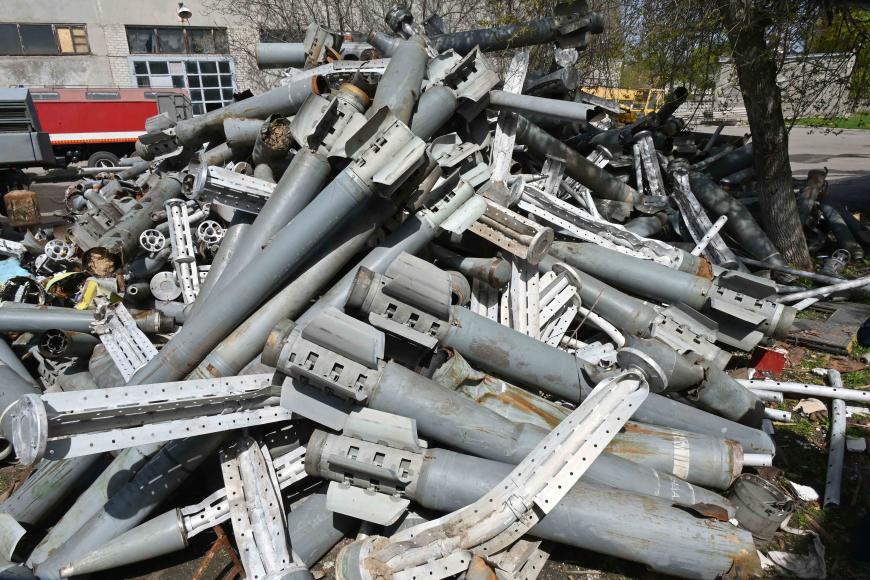
STOCKHOLM - Revenues from sales of arms and military services by the 100 largest companies in the industry reached $632 billion in 2023, a real-terms increase of 4.2 per cent compared with 2022, according to new data released today by the Stockholm International Peace Research Institute (SIPRI).
Arms revenue increases were seen in all regions, with particularly sharp rises among companies based in Russia and the Middle East. Overall, smaller producers were more efficient at responding to new demand linked to the wars in Gaza and Ukraine, growing tensions in East Asia and rearmament programmes elsewhere.
SIPRI Top 100 companies ramp up production and build workforces
In 2023 many arms producers ramped up their production in response to surging demand. The total arms revenues of the Top 100 bounced back after a dip in 2022. Almost three quarters of companies increased their arms revenues year-on-year. Notably, most of the companies that increased their revenues were in the lower half of the Top 100.
‘There was a marked rise in arms revenues in 2023, and this is likely to continue in 2024,’ said Lorenzo Scarazzato, a Researcher with the SIPRI Military Expenditure and Arms Production Programme. ‘The arms revenues of the Top 100 arms producers still did not fully reflect the scale of demand, and many companies have launched recruitment drives, suggesting they are optimistic about future sales.’
US companies’ arms revenues rise, but production challenges remain
The 41 companies in the Top 100 based in the United States recorded arms revenues of $317 billion, half the total arms revenues of the Top 100 and 2.5 per cent more than in 2022. Since 2018, the top five companies in the Top 100 have all been based in the USA.
Of the 41 US companies, 30 increased their arms revenues in 2023. However, Lockheed Martin and RTX, the world’s two largest arms producers, were among those registering a drop.
‘Larger companies like Lockheed Martin and RTX manufacturing a wide range of arms products often depend on complex, multi-tiered supply chains, which made them vulnerable to lingering supply chain challenges in 2023,’ said Dr Nan Tian, Director of SIPRI’s Military Expenditure and Arms Production Programme. ‘This was particularly the case in the aeronautics and missile sectors.’
European arms industry trails rest of world in revenue growth
The combined arms revenues of the 27 Top 100 companies based in Europe (excluding Russia) totalled $133 billion in 2023. This was only 0.2 per cent more than in 2022, the smallest increase in any world region.
However, behind the low growth figure the picture is more nuanced. European arms companies producing complex weapon systems were mostly working on older contracts during 2023 and their revenues for the year consequently do not reflect the influx of orders.
‘Complex weapon systems have longer lead times,’ said Lorenzo Scarazzato. ‘Companies that produce them are thus inherently slower in reacting to changes in demand. That explains why their arms revenues were relatively low in 2023, despite a surge in new orders.’
At the same time, a number of other European producers saw their arms revenues grow substantially, driven by demand linked to the war in Ukraine, particularly for ammunition, artillery and air defence and land systems. Notably, companies in Germany, Sweden, Ukraine, Poland, Norway and Czechia were able to tap into this demand. For instance, Germany’s Rheinmetall increased production capacity of 155-mm ammunition and its revenues were boosted by deliveries of its Leopard tanks and new orders, including through war-related ‘ring-exchange’ programmes (under which countries supply military goods to Ukraine and receive replacements from allies).
Wartime production leads to sharp rise in Russian firms’ arms revenues
The two Russian companies listed in the Top 100 saw their combined revenues increase by 40 per cent to reach an estimated $25.5 billion. This was almost entirely due to the 49 per cent increase in arms revenues recorded by Rostec, a state-owned holding company controlling many arms producers, including seven previously listed in the Top 100 for which individual revenue data could not be obtained.
‘Official data on Russian arms production is scarce and questionable but most analysts believe that the production of new military equipment increased substantially in 2023, while Russia’s existing arsenal underwent extensive refurbishment and modernization,’ said Dr Nan Tian. ‘In particular, combat aircraft, helicopters, UAVs, tanks, munitions and missiles are all thought to have been produced in greater numbers as Russia continued its offensive in Ukraine.’
South Korean and Japanese companies lead revenue growth in Asia and Oceania
The 23 companies in the Top 100 based in Asia and Oceania recorded 5.7 per cent arms revenue growth year-on-year, to reach $136 billion. The four South Korea-based companies recorded a combined 39 per cent increase in arms revenues to reach $11.0 billion. The five companies based in Japan saw their combined arms revenues rise by 35 per cent to $10.0 billion. A policy of military build-up in Japan since 2022 drove a flurry of domestic orders, with some companies seeing the value of new orders increase more than 300 per cent.
‘The sharp growth in arms revenues among South Korean and Japanese companies reflects the bigger picture of military build-ups taking place in the region in response to heightened threat perceptions,’ said Xiao Liang, a Researcher with the SIPRI Military Expenditure and Arms Production Programme. ‘South Korean firms are also trying to expand their share of the global arms market, including demand in Europe related to the war in Ukraine.’
Middle East arms producers see revenue growth linked to Gaza, Ukraine conflicts
Six of the Top 100 arms companies were based in the Middle East. Their combined arms revenues grew by 18 per cent to $19.6 billion. With the outbreak of war in Gaza, the arms revenues of the three companies based in Israel in the Top 100 reached $13.6 billion. This was the highest figure ever recorded by Israeli companies in the SIPRI Top 100. The three companies based in Türkiye saw their arms revenues grow by 24 per cent to $6.0 billion, benefiting from exports prompted by the war in Ukraine and from the Turkish government’s continued push towards self-reliance in arms production.
‘The biggest Middle Eastern arms producers in the Top 100 saw their arms revenues reach unprecedented heights in 2023 and the growth looks set to continue,’ said Dr Diego Lopes da Silva, Senior Researcher with the SIPRI Military Expenditure and Arms Production Programme. ‘In particular, as well as taking in record arms revenues in 2023, Israeli arms producers are booking many more orders as the war in Gaza rages on and spreads.’
Other notable developments
- The nine companies in the Top 100 based in China saw their smallest year-on-year percentage increase in arms revenues (+0.7 per cent) since 2019 amid a slowing economy. Their total arms revenues in 2023 reached $103 billion.
- The combined arms revenues of the three Indian companies in the Top 100 increased to $6.7 billion (+5.8 per cent).
- NCSIST, the only Taiwan-based company in the Top 100, recorded a 27 per cent increase in its arms revenues to $3.2 billion.
- Türkiye’s Baykar produces armed uncrewed aerial vehicles (UAVs) that have been widely used in the war in Ukraine. Exports accounted for around 90 per cent of its arms revenues in 2023, which increased by 25 per cent over the year to $1.9 billion.
- The United Kingdom’s Atomic Weapons Establishment, which designs, manufactures and maintains nuclear warheads, recorded the largest year-on-year percentage increase in arms revenues (+16 per cent) among UK companies in the Top 100, to reach $2.2 billion.
Role of nuclear weapons grows as geopolitical relations deteriorate, SIPRI Yearbook
- Details
- Written by Super User
- Category: Defence & Security
- Hits: 900

STOCKHOLM - The Stockholm International Peace Research Institute (SIPRI) has launched its annual assessment of the state of armaments, disarmament and international security.
Key findings of SIPRI Yearbook 2024 are that the number and types of nuclear weapons in development have increased as states deepen their reliance on nuclear deterrence.
Nuclear arsenals being strengthened around the world
The nine nuclear-armed states—the United States, Russia, the United Kingdom, France, China, India, Pakistan, the Democratic People’s Republic of Korea (North Korea) and Israel—continued to modernize their nuclear arsenals and several deployed new nuclear-armed or nuclear-capable weapon systems in 2023.
Of the total global inventory of an estimated 12 121 warheads in January 2024, about 9585 were in military stockpiles for potential use (see the table below). An estimated 3904 of those warheads were deployed with missiles and aircraft—60 more than in January 2023—and the rest were in central storage. Around 2100 of the deployed warheads were kept in a state of high operational alert on ballistic missiles. Nearly all of these warheads belonged to Russia or the USA, but for the first time China is believed to have some warheads on high operational alert.
‘While the global total of nuclear warheads continues to fall as cold war-era weapons are gradually dismantled, regrettably we continue to see year-on-year increases in the number of operational nuclear warheads,’ said SIPRI Director Dan Smith. ‘This trend seems likely to continue and probably accelerate in the coming years and is extremely concerning.’
India, Pakistan and North Korea are all pursuing the capability to deploy multiple warheads on ballistic missiles, something Russia, France, the UK, the USA and—more recently—China already have. This would enable a rapid potential increase in deployed warheads, as well as the possibility for nuclear-armed countries to threaten the destruction of significantly more targets.
Russia and the USA together possess almost 90 per cent of all nuclear weapons. The sizes of their respective military stockpiles (i.e. useable warheads) seem to have remained relatively stable in 2023, although Russia is estimated to have deployed around 36 more warheads with operational forces than in January 2023. Transparency regarding nuclear forces has declined in both countries in the wake of Russia’s full-scale invasion of Ukraine in February 2022, and debates around nuclear-sharing arrangements have increased in saliency.
Notably, there were several public claims made in 2023 that Russia had deployed nuclear weapons on Belarusian territory, although there is no conclusive visual evidence that the actual deployment of warheads has taken place.
In addition to their military stockpiles, Russia and the USA each hold more than 1200 warheads previously retired from military service, which they are gradually dismantling.
SIPRI’s estimate of the size of China’s nuclear arsenal increased from 410 warheads in January 2023 to 500 in January 2024, and it is expected to keep growing. For the first time, China may also now be deploying a small number of warheads on missiles during peacetime. Depending on how it decides to structure its forces, China could potentially have at least as many intercontinental ballistic missiles (ICBMs) as either Russia or the USA by the turn of the decade, although its stockpile of nuclear warheads is still expected to remain much smaller than the stockpiles of either of those two countries.
‘China is expanding its nuclear arsenal faster than any other country,’ said Hans M. Kristensen, Associate Senior Fellow with SIPRI’s Weapons of Mass Destruction Programme and Director of the Nuclear Information Project at the Federation of American Scientists (FAS). ‘But in nearly all of the nuclear-armed states there are either plans or a significant push to increase nuclear forces.’
Although the UK is not thought to have increased its nuclear weapon arsenal in 2023, its warhead stockpile is expected to grow in the future as a result of the British government’s announcement in 2021 that it was raising its limit from 225 to 260 warheads. The government also said it would no longer publicly disclose its quantities of nuclear weapons, deployed warheads or deployed missiles.
In 2023 France continued its programmes to develop a third-generation nuclear-powered ballistic missile submarine (SSBN) and a new air-launched cruise missile, as well as to refurbish and upgrade existing systems.
India slightly expanded its nuclear arsenal in 2023. Both India and Pakistan continued to develop new types of nuclear delivery system in 2023. While Pakistan remains the main focus of India’s nuclear deterrent, India appears to be placing growing emphasis on longer-range weapons, including those capable of reaching targets throughout China.
North Korea continues to prioritize its military nuclear programme as a central element of its national security strategy. SIPRI estimates that the country has now assembled around 50 warheads and possesses enough fissile material to reach a total of up to 90 warheads, both significant increases over the estimates for January 2023. While North Korea conducted no nuclear test explosions in 2023, it appears to have carried out its first test of a short-range ballistic missile from a rudimentary silo. It also completed the development of at least two types of land-attack cruise missile (LACM) designed to deliver nuclear weapons.
‘Like several other nuclear-armed states, North Korea is putting new emphasis on developing its arsenal of tactical nuclear weapons,’ said Matt Korda, Associate Researcher with SIPRI’s Weapons of Mass Destruction Programme and Senior Research Fellow for the Nuclear Information Project at the Federation of American Scientists. ‘Accordingly, there is a growing concern that North Korea might intend to use these weapons very early in a conflict.’
Israel—which does not publicly acknowledge possessing nuclear weapons—is also believed to be modernizing its nuclear arsenal and appears to be upgrading its plutonium production reactor site at Dimona.
Tensions over Ukraine and Gaza wars further weaken nuclear diplomacy
Nuclear arms control and disarmament diplomacy suffered more major setbacks in 2023. In February 2023 Russia announced it was suspending its participation in the 2010 Treaty on Measures for the Further Reduction and Limitation of Strategic Offensive Arms (New START)—the last remaining nuclear arms control treaty limiting Russian and US strategic nuclear forces. As a countermeasure, the USA has also suspended sharing and publication of treaty data.
In November Russia withdrew its ratification of the Comprehensive Nuclear-Test-Ban Treaty (CTBT), citing ‘an imbalance’ with the USA, which has failed to ratify the treaty since it opened for signature in 1996. However, Russia confirmed that it would remain a signatory and would continue to participate in the work of the Comprehensive Nuclear-Test-Ban Treaty Organization (CTBTO). Meanwhile, Russia has continued to make threats regarding the use of nuclear weapons in the context of Western support for Ukraine. In May 2024 Russia carried out tactical nuclear weapon drills close to the Ukrainian border.
‘We have not seen nuclear weapons playing such a prominent role in international relations since the cold war,’ said Wilfred Wan, Director of SIPRI’s Weapons of Mass Destruction Programme. ‘It is hard to believe that barely two years have passed since the leaders of the five largest nuclear-armed states jointly reaffirmed that “a nuclear war cannot be won and must never be fought”.’
An informal agreement reached between Iran and the USA in June 2023 seemed to temporarily de-escalate tensions between the two countries, which had intensified over Iran’s military support to Russian forces in Ukraine. However, the start of the Israel–Hamas war in October upended the agreement, with proxy attacks by Iran-backed groups on US forces in Iraq and Syria apparently ending Iranian–US diplomatic efforts. The war also undermined efforts to engage Israel in the Conference on the Establishment of a Middle East Zone Free of Nuclear Weapons and Other Weapons of Mass Destruction.
More positively, the June 2023 visit to Beijing by the US secretary of state, Antony Blinken, seems to have increased space for dialogue between China and the USA on a range of issues, potentially including arms control. Later in the year the two sides agreed to resume military-to-military communication.
Global security and stability in increasing peril
The 55th edition of the SIPRI Yearbook analyses the continuing deterioration of global security over the past year. The impacts of the wars in Ukraine and Gaza are visible in almost every aspect of the issues connected to armaments, disarmament and international security examined in the Yearbook. Beyond these two wars—which took centre stage in global news reporting, diplomatic energy and discussion of international politics alike—armed conflicts were active in another 50 states in 2023. Fighting in the Democratic Republic of the Congo and Sudan saw millions of people displaced, and conflict flared up again in Myanmar in the final months of 2023. Armed criminal gangs were a major security concern in some Central and South American states, notably leading to the effective collapse of the state in Haiti during 2023 and into 2024.
‘We are now in one of the most dangerous periods in human history,’ said Dan Smith, SIPRI Director. ‘There are numerous sources of instability—political rivalries, economic inequalities, ecological disruption, an accelerating arms race. The abyss is beckoning and it is time for the great powers to step back and reflect. Preferably together.’
In addition to the usual detailed coverage of nuclear arms control, disarmament and non-proliferation issues, the SIPRI Yearbook presents data and analysis on developments in world military expenditure, international arms transfers, arms production, multilateral peace operations, armed conflicts and more. Special sections in SIPRI Yearbook 2024 explore the role of Russian private military and security companies in conflicts; efforts to reduce the peace and security risks related to artificial intelligence, outer space and cyberspace; and issues around the protection of civilians in the wars in Gaza and Ukraine.
About the SIPRI Yearbook
The SIPRI Yearbook is a compendium of cutting-edge information and analysis on developments in armaments, disarmament and international security. Three major SIPRI Yearbook 2024 data sets were pre-launched in 2023–24: total arms sales by the top 100 arms-producing companies (December 2023), international arms transfers (March 2024) and world military expenditure (April 2024). The SIPRI Yearbook is published by Oxford University Press.
To download SIPRI’s yearbook 2024, visit: https://www.sipri.org/yearbook/2024?utm_source=phpList&utm_medium=email&utm_campaign=For+Immediate+Release%3A+Role+of+nuclear+weapons+grows+as+geopolitical+relations+deteriorate%E2%80%94new+SIPRI+Yearbook+out+now&utm_content=HTML
Which countries have nuclear weapons?
- Details
- Written by Super User
- Category: Defence & Security
- Hits: 1047
HARRIET SINCLAIR
LONDON - Tensions in the Middle East have reached boiling point in recent weeks as Iran fired an unprecedented barrage of missiles at Israel on 13 April, which responded with its own reported missile attack.
Neither country reported any injuries, with Israel confirming that the 300 missiles and drones launched by Iran had been shot down, and Iranian state media saying in turn that Israel had launched three drones that had been taken down by its air defences.
Iran has said it would not retaliate immediately over the attack as the "shadow war" that had long played out between the countries was pushed into the open, prompting fears of a larger-scale regional war.
But a senior commander for the Iranian Revolutionary Guards did warn on Thursday that Iran could review its "nuclear doctrine" if threats from Israel continue - despite Iran currently having no nuclear weapons.
As the situation in the Middle East becomes increasingly fraught, Yahoo News explains which countries have nuclear weapons.
Which countries have nuclear weapons?
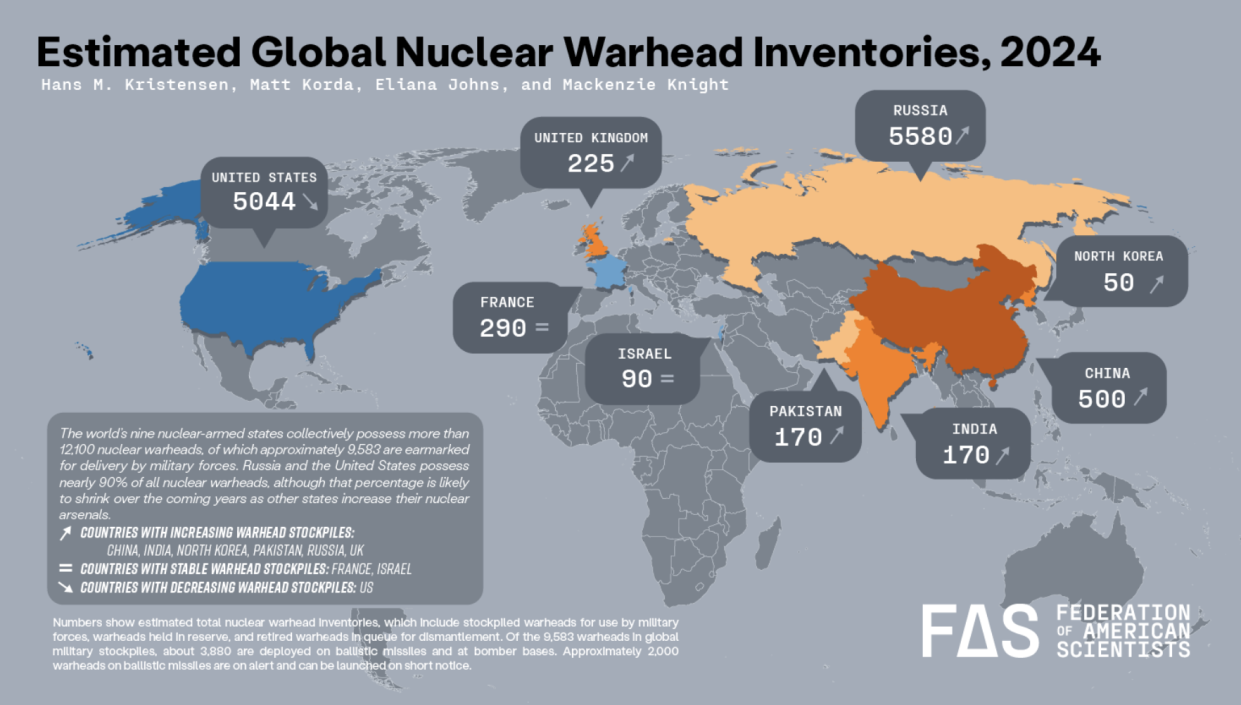
Nine countries currently have nuclear weapons – some legally and some illegally – with an estimated 12,100 warheads between them as of early-2024, according to the Federation of American Scientists (FAS).
Five nations are officially recognised as possessing nuclear arms by the Nuclear Nonproliferation Treaty (NPT).
These are the UK, China, France, the United States and Russia.
But there are also two nations that hold nuclear weapons – India and Pakistan.
Israel and North Korea hold nuclear weapons illegally and the only ones that refuse to sign the non-proliferation treaty.
Russia has the most nuclear weapons followed by the US.
Iran does not have nuclear weapons, however, its store of enriched uranium stood at 5.5 tonnes in February, according to the UN nuclear watchdog. Its uranium is currently enriched to 60% and it theoretically has enough material for two nuclear weapons if enrichment continues, Reuters reports.
Number of nuclear weapons per country
While the official number of nuclear weapons tends to be a state secret, the FAS estimates that Russia has 5,580, as of 2024.
This is closely followed by the US, which has an estimated 5,044.
In fact, the FAS says that approximately 88% of all nuclear warheads are owned by Russia and the US.
Meanwhile, no other nuclear-armed state sees a need for more than a few hundred nuclear weapons for national security.
That's why China, which comes in third, has just 500 in comparison to the thousands owned by Russia and the US.
France follows with an estimated 290 warheads, then the UK with an estimated 225.
How the number of nuclear weapons are distributed around the world
Out of the countries that hold nuclear weapons illegally, the FAS says Pakistan has around 170, India has around 170, Israel has around 90 and North Korea around 50.
But these totals also include weapons that are still intact but are queued for dismantlement.
Israel does not publicly acknowledge it has nuclear weapons.
As countries commit to nuclear disarmament, the number of weapons that remain in their military stockpiles is decreasing.
These stockpile numbers can also be broken down into different categories depending on whether the weapons are deployed on launchers at military bases or are being kept in reserve.
According to the FAS, the entire "military stockpile" includes all active and inactive warheads that are in the custody of the military and earmarked for use by commissioned delivery vehicles.
Meanwhile, "deployed strategic warheads" are those deployed on intercontinental missiles and at heavy bomber bases.
Currently, there are 9,583 nuclear warheads in military stockpiles (that can be used for missiles, aircraft, ships and submarines).
Of these, 3,880 are deployed, while there are 2,000 "high alert" warheads that belong to the US, Russia, Britain and France, which can be deployed at short notice.
"Deployed nonstrategic warheads" are those deployed on bases with operational short-range delivery systems.
Most warheads in the world are in reserve or "non-deployed", meaning they are in storage rather than deployed at military bases.
For Israel, Pakistan, India and North Korea, their entire military stockpiles are non-deployed, according to the FAS – meaning none are currently deployed.
Only two nuclear weapons have ever been used in warfare since they were first developed by the US during the Second World War.
The US dropped two bombs on the cities of Hiroshima and Nagasaki in 1945, killing almost 200,000 people in total.
Both Russia and the US continued to build up their stockpile of nuclear weapons during the Cold War as tensions escalated.
The latest nation to build nuclear weapons is North Korea, which carried out its first nuclear test in 2006.
The FAS estimates there have been over 2,000 nuclear tests conducted to date.
Since the Cold War, the global nuclear stockpile has massively diminished - down from around 70,300 in 1986 to around 12,100 in 2024.
Arms sales revenue delayed by production challenges and backlogs
- Details
- Written by northsouth
- Category: Defence & Security
- Hits: 973
Stockholm - Revenues from sales of arms and military services by the 100 largest companies in the industry totalled $597 billion in 2022, 3.5 per cent less than 2021 in real terms, even as demand rose sharply, according to new data released today by the Stockholm International Peace Research Institute (SIPRI), available at www.sipri.org.
The decrease was chiefly the result of falling arms revenues among major companies in the United States. Revenues increased substantially in Asia and Oceania and the Middle East. Outstanding orders and a surge in new contracts suggest that global arms revenues could rise significantly in the next few years.
Demand for weapons grows but production lags behind
Russia’s full-scale invasion of Ukraine and geopolitical tensions around the world fuelled a strong increase in demand for weapons and military equipment in 2022. However, despite receiving new orders, many US and European arms companies could not significantly ramp up production capacity because of labour shortages, soaring costs and supply chain disruptions that were exacerbated by the war in Ukraine. In addition, countries placed new orders late in the year and the time lag between orders and production meant that the surge in demand was not reflected in these companies’ 2022 revenues.
‘Many arms companies faced obstacles in adjusting to production for high-intensity warfare,’ said Dr Lucie Béraud-Sudreau, Director of SIPRI’s Military Expenditure and Arms Production Programme. ‘However, new contracts were signed, notably for ammunition, which could be expected to translate into higher revenue in 2023 and beyond.’
In contrast to the major US and European suppliers, companies in Asia and Oceania and the Middle East saw their arms revenues grow significantly in 2022, demonstrating their ability to respond to increased demand within a shorter time frame. This was especially true in countries where companies maintain responsive ‘ever-warm’ manufacturing capabilities, such as Israel and South Korea, and those where companies tend to rely on short supply chains.
Arms revenues fall in USA due to production challenges
The arms revenues of the 42 US companies in the Top 100 fell by 7.9 per cent to $302 billion in 2022. They accounted for 51 per cent of the total arms revenue of the Top 100. Of the 42 US companies, 32 recorded a fall in year-on-year arms revenue, most commonly citing ongoing supply chain issues and labour shortages stemming from the Covid-19 pandemic.
‘We are beginning to see an influx of new orders linked to the war in Ukraine and some major US companies, including Lockheed Martin and Raytheon Technologies, received new orders as a result,’ said Nan Tian, SIPRI Senior Researcher. ‘However, because of these companies’ existing order backlogs and difficulties in ramping up production capacity, the revenue from these orders will probably only be reflected in company accounts in two to three years’ time.’
Asia outperforms Europe on back of military modernization drives
The arms revenues of the 22 companies from Asia and Oceania listed in the ranking rose by 3.1 per cent to reach $134 billion in 2022. This was the second consecutive year where Top 100 arms revenues for Asia and Oceania were higher than those for Europe.
‘Domestic demand and reliance on local suppliers shielded Asian arms companies from supply chain disruptions in 2022,’ said Xiao Liang, a researcher with the SIPRI Military Expenditure and Arms Production Programme. ‘Companies in China, India, Japan and Taiwan all benefited from sustained government investment in military modernization.’
The combined arms revenues of the four South Korean companies in the Top 100 fell by 0.9 per cent, primarily due to an 8.5 per cent drop recorded by the country’s biggest arms producer, Hanwha Aerospace. Two South Korean companies reported revenue growth, most notably LIG Nex1. South Korean companies are likely to see increased revenues in coming years due to a surge in booked orders after signing major arms deals with Poland and the United Arab Emirates.
Modest revenue growth in Europe as Ukraine-linked demand starts to filter through
The arms revenues of the 26 companies in the Top 100 based in Europe rose by 0.9 per cent to reach $121 billion in 2022.
‘The war in Ukraine created demand for materiel suited to a war of attrition, like ammunition and armoured vehicles. Many European producers of these items saw their revenues grow,’ said Lorenzo Scarazzato, a researcher with the SIPRI Military Expenditure and Arms Production Programme. ‘They included companies based in Germany, Norway and Poland. For instance, Poland’s PGZ increased its arms revenue by 14 per cent, benefiting from the accelerated military modernization programme the country is pursuing.’
Trans-European companies Airbus and KNDS were among the main sources of arms revenue growth in Europe, largely due to deliveries against long-standing orders.
Turkish companies drive significant increase in Middle Eastern arms revenue
The Middle East saw the largest percentage rise in arms revenue of any region in 2022, as all seven Middle East-based companies in the Top 100 recorded substantial growth. Their combined arms revenues of $17.9 billion marked an 11 per cent year-on-year increase. The four Turkish companies’ total arms revenues reached $5.5 billion—22 per cent more than in 2021. The aggregate arms revenues of the three Israeli companies in the ranking reached $12.4 billion in 2022, a 6.5 per cent increase compared with 2021.
‘Middle Eastern companies that specialize in less technologically sophisticated products were able to scale up production faster in response to surging demand,’ said Dr Diego Lopes da Silva, SIPRI Senior Researcher. ‘A case in point is Türkiye’s Baykar, producer of the Bayraktar TB-2 drone. Baykar entered the Top 100 for the first time after its arms revenue rose by 94 per cent, the fastest growth rate of any company in the ranking.’
Other notable developments
- In 2022 China accounted for the second largest share of combined Top 100 arms revenues by country, at 18 per cent. The aggregate arms revenues of the eight Chinese arms companies in the ranking increased by 2.7 per cent to $108 billion.
- The arms revenues of the seven companies in the United Kingdom listed in the Top 100 grew by 2.6 per cent to reach $41.8 billion, or 7.0 per cent of the total.
- Due to a lack of data, only two Russian companies were included in the Top 100 for 2022. Their combined arms revenues fell by 12 per cent to $20.8 billion. Transparency among Russian companies continues to decline. Despite being a holding entity with no direct manufacturing capacity, Rostec is included in the 2022 ranking as a proxy for the companies it controls.
- The only Ukrainian company in the Top 100, UkrOboronProm, saw a 10 per cent real-terms drop in its arms revenue to $1.3 billion. Although its arms revenue increased in nominal terms, this was more than offset by the country’s high inflation.
For the full report, visit: https://www.sipri.org/sites/default/files/2023-11/fs_2312_top_100_2022.pdf
Main News
Error: No articles to display
latest news
- New blood test can spot breast cancer at earliest stages, scientists
- Sole bidders Saudi Arabia confirmed as hosts of 2034 men’s World Cup
- Nagasaki survivor accepts Nobel Peace Prize, calls for nuclear free world
- Countering Collapse in Haiti
- Crude oil price and production movements, OPEC
- IFAD, Nepal launch $120 million programme to help over 250,000 people
- DiEM25 challenges EU’s inhumane practices towards migrants
- Malibu wildfires forced thousands to evacuate their homes
- DRC: Senior army officials must be investigated for possible crimes
- Netanyahu describes corruption charges against him as ‘ocean of absurdity’ at trial
- Authorities disrupt migrant smuggling supply chain
- Israeli tanks '16 miles from Damascus' as overnight raids 'destroy Assad army's assets'
- In Haiti, women suffer the consequences of gang violence
- ICC arrest warrants for top Israeli officials are step toward justice
- Poland: Brutal Pushbacks at Belarus Border
- Sudan: War Crimes in South Cordovan, HRW
- Europeans politicians quick to promote hate against Syrian refugees
- Pentagon announces $988 million Ukraine Security Assistance package
- Trump says Russia, Iran in 'weakened state,' calls on Putin to make Ukraine deal
- $1.7 billion in airline funds blocked by governments
- 12 Ways to improve circulation for healthy blood flow, Doctors
- Action against ‘phone phishing’ gang in Belgium, Netherlands: 8 arrests
- $282 million program targeting agriculture and food systems
- What’s happening in Syria? The key developments as Assad flees to Russia
- UK nearly as divided as the US, report finds
Europe
DiEM25 challenges EU’s inhumane practices towards migrants
Authorities disrupt migrant smuggling supply chain
ICC arrest warrants for top Israeli officials are step toward justice
Poland: Brutal Pushbacks at Belarus Border
Europeans politicians quick to promote hate against Syrian refugees
Action against ‘phone phishing’ gang in Belgium, Netherlands: 8 arrests
UK nearly as divided as the US, report finds
Starmer rejects choice between EU and US allies
French government at risk of collapsing over 2025 budget
Belgium convicted of crimes against humanity for acts committed during colonisation
23rd International Economic Forum on Africa Monday 9 December
Putin Approves New Budget With Record Defence Spending
UK MPs back Assisted dying bill after emotionally-charged Commons debate
Ireland goes to polls with three parties neck and neck
Putin full of praise for ‘intelligent and experienced’ Trump
UK to continue selling arms to Israel despite Lebanon ceasefire, Starmer says
Crackdown on illegal streaming network with 22 million users worldwide
France says Israel's Netanyahu has immunity from ICC arrest warrant
Number of Europeans diagnosed with HIV rose in 2023 with new cases in most countries
Georgian prime minister suspends EU membership talks until end of 2028
Russian missile fired at Ukraine carried warheads without explosives
Russia advances in Ukraine at fastest monthly pace since start of war
Why are news outlets not covering crackdown on pro-Palestinian journalists in UK?
Starmer and Lammy are ‘monstrous war criminals’, Palestinian lawyer
Storm Bert brings severe flooding across UK
Asia
Nagasaki survivor accepts Nobel Peace Prize, calls for nuclear free world
IFAD, Nepal launch $120 million programme to help over 250,000 people
Embezzling property tycoon scrambles to raise $9bn to avoid death sentence
Pakistan: Everything we know about clashes between Imran Khan supporters and police
India: Mosque survey dispute erupts into deadly clashes
Taliban detained journalists over 250 times since takeover, UN
Philippines summons VP Duterte over threat to have Marcos killed
Four troops killed in Pakistan as protesters demand release of ex-PM Khan
Thousands of Imran Khan supporters defy arrest to head to capital
Pakistan sealing off capital ahead of planned rally by Imran Khan supporters
Fighting between armed sectarian groups in Pakistan kills at least 33 people
Rise in Afghan opium cultivation reflects economic hardship
Volcano erupts in Bali spewing five-mile ash cloud
New Delhi becomes world’s most polluted city as AQI levels reach 1,000
Pakistan’s toxic smog cover is now visible from space
Chinese driver 'angry about divorce settlement' ploughs into crowd leaving 35 dead
Taliban to attend UN climate conference for first time
Suicide bomber kills 24 in explosion at Pakistan train station
China unveils new heavy rocket that looks similar to SpaceX Starship
North Korea’s new ICBM missile records longest flight time yet
Japanese youth committed to fight poverty and hunger with IFAD
Japan's government in flux after election gives no party majority
Indan Muslims face discrimination after restaurants forced to display workers’ names
IFAD and Thailand sign agreement for new regional office in Bangkok
Nobel Peace Prize was awarded to the Japanese organization Nihon Hidankyo
Africa
DRC: Senior army officials must be investigated for possible crimes
Sudan: War Crimes in South Cordovan, HRW
Angola: US President Biden must demand immediate release of five critics
Wife of 'abducted' Ugandan opposition figure says he won't get justice
S.Africa opposition seeks to revive impeachment proceedings against Ramaphosa
Namibia may elect its first-ever female president in elections this week
Botswana turns to cannabis as diamonds are’s for ever
Influencers and social media beat mainstream media in Kenya
Mali’s ruling military appoints new prime minister
Regenerative Agriculture and Peace-building in South-central Somalia
Wits University unveils pan-African AI centre
'The UK will never forget Sudan,' says David Lammy
Sudan’s displaced have endured ‘unimaginable suffering, brutal atrocities’
Nearly half the world’s 1.1 billion poor live in conflict settings
Sudan war deaths are likely much higher than recorded
Africa’s mineral deposits can power the energy transition
The joint force of the AES ready to launch large-scale operations to secure Sahel
Mystery still surrounds death of revered UN chief Hammarskjöld, 63 years after plane crash
IFAD and Sierra Leone partner to boost farm productivity
Mozambique: End violent post-election crackdown ahead of 7 November Maputo march
Africa: Richer countries must commit to pay at COP29
Sudan’s ‘living nightmare’ continues as 11 million flee war
‘Alarming’ situation in Great Lakes Region of DR Congo
Climate change worsened rains in flood-hit African regions, scientists
African progress backslides as coups and war persist
Americas
Countering Collapse in Haiti
Malibu wildfires forced thousands to evacuate their homes
In Haiti, women suffer the consequences of gang violence
Pentagon announces $988 million Ukraine Security Assistance package
Trump says Russia, Iran in 'weakened state,' calls on Putin to make Ukraine deal
Musk dealt legal defeat in battle over $56 billion Tesla pay deal
Autonomous Systems Impact on Modern Warfare
US, Israel, China, and the Shifting Arms Trade in the Middle East
Support the Court, HRW
Private prisons in US stand to cash in from Trump’s mass deportation plan
G7 Foreign Ministers’ Meeting Statement
War Crimes Weapons: Made in the USA
Trump Cabinet and executive branch of different ideas and eclectic personalities
Trump Says He Will Impose 25% Tariff on Canada and Mexico on Day one
Prosecutors drop election interference and documents cases against Trump
Number of children recruited by gangs in Haiti soars by 70%, UNICEF
Archaeologists discover 4,000-year-old canals used to fish by predecessors of ancient Maya
Democrats in Congress urge Biden to sanction Israelis over West Bank violence
Susan Sarandon opens up on exile from Hollywood after PRO-Palestine remarks
What could Trump’s election win mean for Ukraine and the Middle East
Trump deploys garbage truck to trash Biden gaffe at Wisconsin rally
US calls on Israel to tackle ‘catastrophic humanitarian crisis’ in Gaza
Vinicius's Ballon d’Or snub sparks fury in Brazil amid claims of racism
CNN guest thrown off air after telling Mehdi Hasan:‘I hope your beeper doesn’t go off’
Pentagon warns North Korea as 10,000 troops set to join Russia’s war
Australia & Pacific
Australia passes world-first ban on social media for under 16s into law
New Zealanders save over 30 stranded whales by lifting them on sheets
Commonwealth leaders say 'time has come' for discussion on slavery reparations
Generational export reforms to boost AUKUS trade and collaboration
Australia lawmaker calls opposition leader racist over opposition to Gaza refugees
Agreement strengthens AUKUS submarine partnership
Passionate welcome for WikiLeaks founder Assange as he lands in Australia
Violent protests return to New Caledonia as pro-independence leader extradited
EU and Australia accelerate their digital cooperation
Over 2,000 people thought to have been buried alive in Papua New Guinea landslide
Over 670 people died in a massive Papua New Guinea landslide, UN
Macron says extra security to stay in riot-hit New Caledonia as long as needed
New Caledonia riots: Tourists evacuated, President Macron to visit
Hundreds more French police start deploying to secure New Caledonia
France declares state of emergency in New Caledonia as protests rage
Australia’s 2024 National Defence Strategy
Sydney rocked by second mass stabbing as knifeman attacks bishop
Three dead, 1,000 homes destroyed in Papua New Guinea quake
Australia and UK sign defense and security treaty
Australia tightens student visa rules as migration hits record high
Global food crisis and the effects of climate change need urgent action, IFAD
Indonesia, Australia to sign defence pact within months
Australia to ban doxxing after pro-Palestinians publish information about hundreds of Jews
Australia launches inquiry into why Cabinet documents relating to Iraq war remain secret
Australia says AI will help track Chinese submarines under new Aukus plan
MENA
Netanyahu describes corruption charges against him as ‘ocean of absurdity’ at trial
Israeli tanks '16 miles from Damascus' as overnight raids 'destroy Assad army's assets'
What’s happening in Syria? The key developments as Assad flees to Russia
Who is Abu Mohammed al-Golani, leader of insurgency that toppled Syria’s Assad?
Syrian leader Bashar Assad in Moscow, State news agency
IFAD and Kuwait agree to strengthen efforts to support small-scale farmers
Israel responds to Hezbollah rocket attack with airstrikes on south Lebanon
Egypt: Education Restricted for Refugee
At least 25 killed in counter air strikes by Syrian army on rebels in north-west
UNRWA suspends aid delivery to Gaza after lorries looted at gunpoint
Who are the Syrian rebels HTS and why are they advancing?
Syrian rebels capture centre of Aleppo in major blow to Assad regime
World Central Kitchen stops work in Gaza after three aid workers killed by Israeli strike
Lebanon must elect president during 60-day truce with Israel as part of ceasefire
Abbas clarifies PA presidency succession plan but experts unconvinced
At least 10 killed in Israeli air strike on Beit Lahia
UN calls for accountability and investigations in Israel-Hezbollah conflict
Saudi Arabia approves 2025 budget with estimated $315bn
Lebanon faces $25bn reconstruction bill after Israel-Hezbollah ceasefire
Israeli military to remain in Gaza for years, food minister says
Israeli government orders officials to boycott left-leaning paper Haaretz
In East Jerusalem, record number of homes destroyed to drive out Palestinian residents
Biden: Israel and Hezbollah Ceasefire deal can be blueprint to end Gaza war
Heavy rain and high waves wash away tents of Gaza's displaced
Saudi NEOM gigaproject a 'generational investment,' minister
Banners



Videos
-
Future of car-plane, see it to believe it
https://www.youtube.com/watch?v=D4uSWtazRCM
-
Mehdi Hasan: Islam is a peaceful religion
https://www.youtube.com/watch?v=Jy9tNyp03M0 -
Python swallows antelope whole in under an hour
https://www.youtube.com/watch?v=x0rk5zh7RaE
-
Sangoku dance
http://www.youtube.com/watch?v=Df1SkeiPEAo -
flying 3 kites wonder!
https://www.youtube.com/watch?v=nr9KrqN_lIg
-
Korea has talent
http://www.youtube.com/watch?v=tZ46Ot4_lLo&feature=related -
Paul Potts sings Nessun Dorma
http://www.youtube.com/watch?v=1k08yxu57NA
-
Susan Boyle - Britain's Got Talent
http://www.youtube.com/watch?v=RxPZh4AnWyk -
Twist and Pulse - Britain's Got Talent
http://www.youtube.com/watch?v=1RDiBxbT_CA -
Shaheen Jafargholi (HQ) Britain's Got Talent
http://www.youtube.com/watch?v=VYDM3MIzEHo
High-Quality clip of 12-year-old singer Shaheen Jafargholi auditioning on Britain's Got Talent 2009. First he sings Valerie by The Zutons, as performed by Amy Winehouse, but, after Simon interrupts him and asks for a different song, he just blew everyone away. -
David Calvo juggles and solves Rubik's Cubes
http://www.youtube.com/watch?v=lhkzgjOKeLs
-
Outdoor 'bubble pod' hotel unveiled
http://www.youtube.com/watch?v=9IPBKlWf-cA