
Home
Gaza destruction impossible to even process, UN humanitarian says
- Details
- Written by Super User
- Category: MENA
- Hits: 567
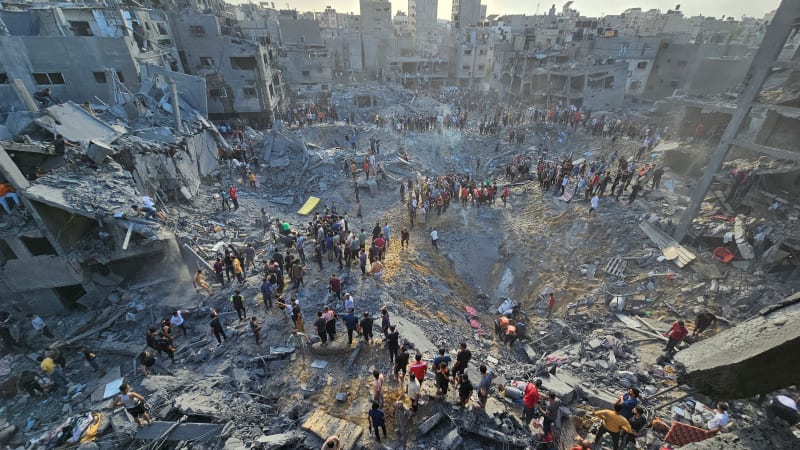
GENEVA - After nearly seven months of war in Gaza, nowhere is safe, people are scared, and everyone is hanging on to hopes of a ceasefire.
That’s the message from Louise Wateridge, Communications Officer with the UN agency that assists Palestine refugees, UNRWA, who is stationed in the southern city of Rafah.
Ms. Wateridge had worked with UNRWA before and recently returned to the region and was shocked by what she saw on a visit to Gaza City, a place she knows well.
Unbelievable devastation
“It didn’t feel real seeing out of every single window in the car, as far as you could see was just destruction,” she told UN News.
Ms. Wateridge has been using her mobile phone to document the devastation in places such as Khan Younis, where she visited an abandoned UNRWA school-turned-shelter that once housed tens of thousands of displaced people who hastily fled the facility ahead of Israeli bombardment.
“It was devastating to see unmarked graves, even in the corner of our facility in the Khan Younis Training Centre,” she said. “On the wall above one of the children's graves there was a message saying ‘Marwa, your sister misses you and loves you.’”
This interview has been edited for clarity and length.
Louise Wateridge: Over the last couple of days I've been to Gaza City and Jabalia camp, and also in Khan Younis. I've worked in the region for the last four years, so it's my first time being here since the war began and it's just unbelievable to see Gaza City. We went with the World Food Programme (WFP) on a joint mission to the Jabalia camp. The agencies are working very closely in the north to try to expand food distribution there. But the drive up was absolutely shocking for me. Just this city that I've known for years, and seeing everything around you just completely flattened.
There were homes because you could see where they were still standing. There were walls missing, and you could see into the living rooms, into the dining rooms. It's like there was life there. You can very clearly see life there - pictures on the wall, clothes kind of around the room - but there's nobody in there. It was a very haunting, shocking experience.
You referenced the video I took. I was sitting in the front of the car. Everywhere I was looking there was destruction. Your mind can't even process that it's real to see that much devastation in front of you.
But then as we went to Jabalia, the markets kind of pick up and you see more people around. The really good news from our trip is it appears that within the last few weeks, there's been a lot more commercial food on the market, so there were a lot more people at the markets.
My colleagues who have been here a lot longer than I have were explaining that two or three weeks ago, it was a very different place. People were very, very hungry; very scared. There was not a lot available in the market, whereas when we went this weekend, it was very positive to see that that had somewhat shifted. The agencies are going to continue to work together, UNRWA and WFP, to make sure that people in the north do have the food that they need after all of this time.
UN News: Was UNRWA able to provide any assistance during this trip to Jabalia?
Louise Wateridge: The trip was more of an assessment to review the facilities that UNRWA has. 165 facilities across the Gaza Strip have been attacked or damaged, so we really need some space and some warehouse and distribution areas that we can offload the food and then distribute to the community.
So, this trip was an assessment of those facilities to see where we could restore, where we could start using again. There was one warehouse that had bullet holes throughout the roof and some of them had walls missing, so they really are in a very bad way, and they've been very severely damaged.
We also visited our colleagues. I was with the Director of UNRWA affairs in Gaza, Scott Anderson, and he was talking to and meeting with our colleagues in the north in Jabalia who have been running the health services throughout the whole duration of the war.
We have a group of incredible colleagues who have still been going to work every day. They themselves are displaced. I spoke to some of the women in the group and it's devastating. They've all lost something. Many of them have lost more than you can imagine. And they talk about how they have homes now without walls that they're still living in.
They really have gone a very long time without food. They discuss the struggles they've had with going to work and serving the community, and then going home to their children in the evening, trying to put food on the table while they're still at work all the time.
UN News: Do they feel a little safer now?
Louise Wateridge: I don't think anyone feels safe. No, not at all. There was a feeling of slight relief that there was more food available. Even just seeing UNRWA and WFP working together in the north, they were very hopeful for this opportunity that these two organizations will expand the food distribution in the area. But they're tired. They're very tired. They're very scared.
They've been through more than we could imagine the last six-and-a-half months. And they are very scared of what tomorrow brings. They are very scared if more military action will happen. They're scared if they'll be displaced again. They're scared of the nights.
They explained that they get home with their children and how their children feel at home; the way they sleep together and huddle together in fear. There's just no safety here. No one feels safe.
UN News: Tell us about your trip to Khan Younis
Louise Wateridge: We went to Khan Younis on a joint mission with the UN Mine Action Service (UNMAS) to sweep the area and assess the area for any potential shrapnel, any potential unexploded ordnance in the UNRWA facilities there. It was devastating to see the facilities that we visited – a training centre, health clinic and two schools. I know all of these facilities from before the war, so it was completely devastating to see the condition that they were in now. And the thing that really shocked me the most was it was very evident how quickly people had fled these facilities. We're talking about four huge UNRWA compounds.
There were tens of thousands of people sheltering in these UNRWA facilities, and almost overnight they had to evacuate. There was an Israeli forces’ warning to evacuate Khan Younis and evacuate these UNRWA facilities.
Walking around, there were shoes, children's shoes – one here, one there; toothbrushes, hairbrushes, clothes, socks. You could see kind of half-eaten food.
And it just seemed that everything had been abandoned very, very quickly. Nobody had the luxury to pack up even what they had there, and it's not like they had an abundance of things with them at this point. And yet, there was still so much left behind.
Some of our colleagues in the training centre were sharing their experiences of this situation, saying how terrified they were then, how terrifying it was for everyone sheltering there. They really had to evacuate within a matter of hours.
It was devastating to see unmarked graves, even in the corner of our facility in the Khan Younis Training Centre. There were some graves for children. On the wall above one of the children's graves there was a message saying “Marwa, your sister misses you and loves you.”
You cannot believe it's a UN facility. You cannot believe that this is a place that people thought they were safe. Walls of the perimeter were completely knocked down.
Bullet holes throughout every room, almost every classroom. There was clear damage to the roof that had come through. So, the whole experience in Khan Younis was devastating, really beyond devastating.
UN News: I would like to ask you about our colleague Abdullah, the photojournalist who survived the bombardment in the north but had to have his legs amputated. Could you tell us more about his condition?
Louise Wateridge: We had some really good news this week that our colleague Abdullah was medically evacuated out of Gaza and is now in Doha, so we're absolutely thrilled. Everyone at UNRWA is so relieved that he and his family are no longer in Gaza. I saw Abdullah on Tuesday, alongside some colleagues who had been visiting him regularly at a field hospital in Rafah.
He needed further surgery that wasn't possible in Gaza City due to the facility he was in and the medical supplies that were available, so we're very relieved that he will now be able to receive this treatment. It's been a horrific journey for Abdullah.
He was taken to Al-Shifa hospital where he initially received treatment. This hospital was then under siege by Israeli forces for two weeks, and Abdullah was inside for the whole duration. We cannot imagine what Abdullah has been through, and we're all just very relieved and very thankful that he is now getting the treatment that he needs.
UN News: Finally, in the beginning of the interview, you said that this is not your first time in Gaza. What comes to mind when you see all of this devastation and reflect on your previous experiences? And what's your message?
Louise Wateridge: Gaza to me has always been a wonderful place to work. The colleagues here are some of the best I've ever worked with, not just with UNRWA but anywhere in the world.
I feel so privileged to have these colleagues and friends in my life and it's just appalling to see the lives that they are now living. I think for everyone, it's like their life ended and then something else has begun.
My colleague Hussein was showing me pictures and videos of his new apartment that he was moving into at the beginning of October. He showed me a video of the building today and it's completely destroyed.
Everyone has the same story where they're now sleeping under plastic sheeting; they’re crammed into rooms with all of their family and neighbours. Nobody knows what's coming next. Everybody is visibly tired.
I know so many familiar faces here but they all look so different after the last six and a half months. You can just see the suffering a lot of people have been through.
They've lost a lot of weight, collectively. Everybody has changed so significantly in what is quite a short amount of time. But they're all wearing this war.
And I think the biggest problem is they just don't know what tomorrow brings. There’s a lot of fear for their children. Every day, people wonder if a ceasefire is coming. And that's what everyone's hanging on to.
Mass graves in Gaza show victims' hands were tied, says UN rights office
- Details
- Written by Super User
- Category: MENA
- Hits: 588
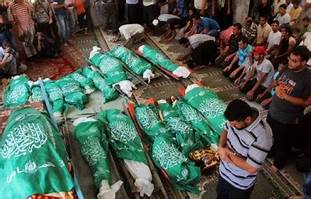
GENEVA - Disturbing reports continue to emerge about mass graves in Gaza in which Palestinian victims were reportedly found stripped naked with their hands tied, prompting renewed concerns about possible war crimes amid ongoing Israeli airstrikes, the UN human rights office, OHCHR, said on Tuesday.
The development follows the recovery of hundreds of bodies "buried deep in the ground and covered with waste" over the weekend at Nasser Hospital in Khan Younis, central Gaza, and at Al-Shifa Hospital in Gaza City in the north. A total of 283 bodies were recovered at Nasser Hospital, of which 42 were identified.
"Among the deceased were allegedly older people, women and wounded, while others were found tied with their hands...tied and stripped of their clothes," said Ravina Shamdasani, spokesperson for the UN High Commissioner for Human Rights.
Al-Shifa discovery
Citing the local health authorities in Gaza, Ms. Shamdasani added that more bodies had been found at Al-Shifa Hospital.
The large health complex was the enclave's main tertiary facility before war erupted on 7 October. It was the focus of an Israeli military incursion to root out Hamas militants allegedly operating inside which ended at the beginning of this month. After two weeks of intense clashes, UN humanitarians assessed the site and confirmed on 5 April that Al-Shifa was "an empty shell", with most equipment reduced to ashes.
"Reports suggest that there were 30 Palestinian bodies buried in two graves in the courtyard of Al-Shifa Hospital in Gaza City; one in front of the emergency building and the others in front of the dialysis building," Ms. Shamdasani told journalists in Geneva.
The bodies of 12 Palestinians have now been identified from these locations at Al-Shifa, the OHCHR spokesperson continued, but identification has not yet been possible for the remaining individuals.
"There are reports that the hands of some of these bodies were also tied," Ms. Shamdasani said, adding that there could be "many more" victims, "despite the claim by the Israeli Defense Forces to have killed 200 Palestinians during the Al-Shifa medical complex operation".
200 days of horror
Some 200 days since intense Israeli bombardment began in response to Hamas-led terror attacks in southern Israel, UN human rights chief Volker Türk expressed his horror at the destruction of Nasser and Al-Shifa hospitals and the reported discovery of mass graves.
"The intentional killing of civilians, detainees and others who are hors de combat is a war crime," Mr. Türk said in a call for independent investigations into the deaths.
Mounting toll
As of 22 April, more than 34,000 Palestinians have been killed in Gaza, including 14,685 children and 9,670 women, the High Commissioner's office said, citing the enclave's health authorities. Another 77,084 have been injured, and over 7,000 others are assumed to be under the rubble.
"Every 10 minutes a child is killed or wounded. They are protected under the laws of war, and yet they are ones who are disproportionately paying the ultimate price in this war," said the High Commissioner.
Türk warning
The UN rights chief also reiterated his warning against a full-scale Israeli incursion of Rafah, where an estimated 1.2 million Gazans "have been forcibly cornered".
"The world's leaders stand united on the imperative of protecting the civilian population trapped in Rafah," the High Commissioner said in a statement, which also condemned Israeli strikes against Rafah in recent days that mainly killed women and children.
This included an attack on an apartment building in the Tal Al Sultan area on 19 April which killed nine Palestinians "including six children and two women", along with a strike on As Shabora Camp in Rafah a day later that reportedly left four dead, including a girl and a pregnant woman.
"The latest images of a premature child taken from the womb of her dying mother, of the adjacent two houses where 15 children and five women were killed, this is beyond warfare," said Mr. Türk.
The High Commissioner decried the "unspeakable suffering" caused by months of warfare and appealed once again for "the resulting misery and destruction, starvation and disease and the risk of wider conflict" to end.
Mr. Türk also reiterated his call for an immediate ceasefire, the release of all remaining hostages taken from Israel and those held in arbitrary detention and the unfettered flow of humanitarian aid.
Massive settler attacks in West Bank
Turning to the West Bank, the UN rights chief said that grave human rights violations had continued there "unabated".
This was despite international condemnation of "massive settler attacks" between 12 and 14 April "that had been facilitated by the Israeli Security Forces (ISF)".
Settler violence has been organized "with the support, protection, and participation of the ISF", Mr. Türk insisted, before describing a 50-hour long operation into Nur Shams refugee camp and Tulkarem city starting on 18 April.
"The ISF deployed ground troops, bulldozers and drones and sealed the camp. Fourteen Palestinians were killed, three of them children," the UN rights chief said, noting that 10 ISF members had been injured.
In a statement, Mr. Türk also highlighted reports that several Palestinians had been unlawfully killed in the Nur Shams operation "and that the ISF used unarmed Palestinians to shield their forces from attack and killed others in apparent extrajudicial executions".
Dozens were reportedly detained and ill-treated while the ISF "inflicted unprecedented and apparently wanton destruction on the camp and its infrastructure", the High Commissioner said.
Palestinians forced to flee homes as Israel pounds northern Gaza
- Details
- Written by Super User
- Category: MENA
- Hits: 557
By Nidal Al-Mughrabi
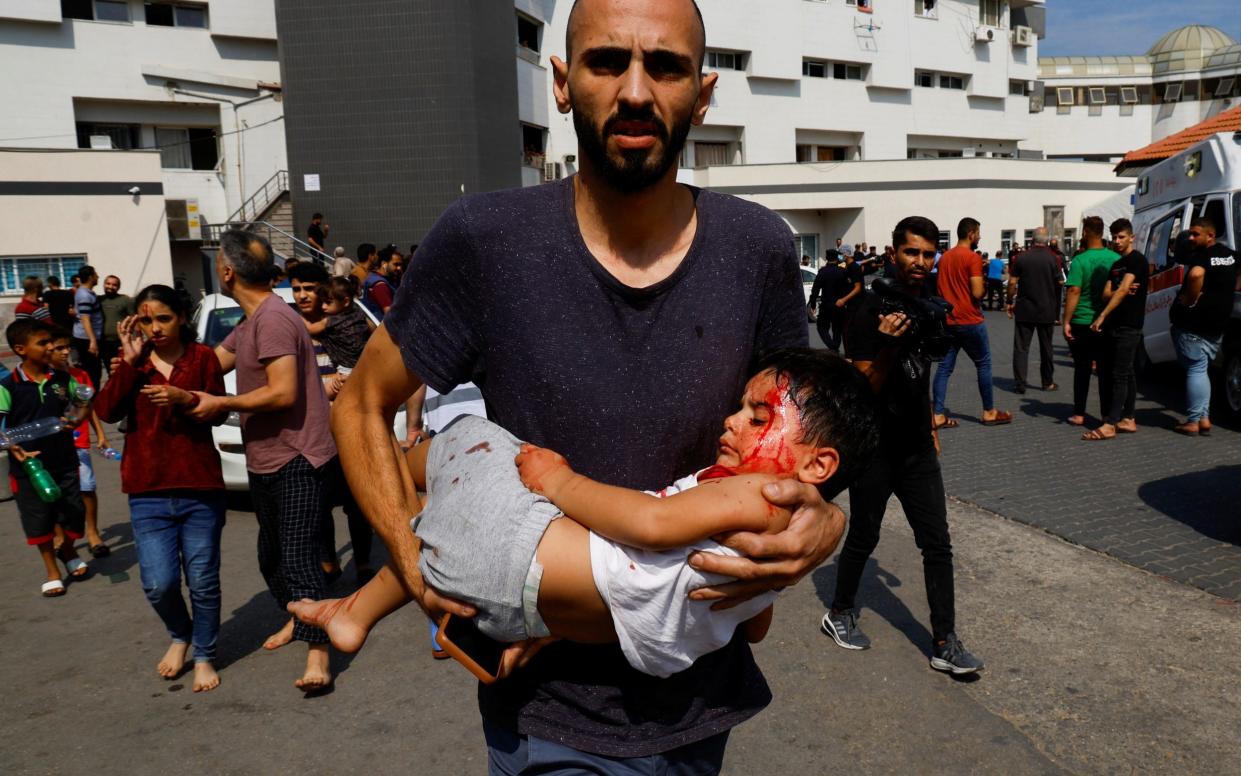
Deir Al-Balah, central Gaza Strip - Some Palestinian civilians were fleeing their homes in northern Gaza on Wednesday just weeks after returning because of an Israeli bombardment which they said was as intense as those at the start of the war.
Much of the shelling was focused for a second day on Beit Lahiya on the northern edge of Gaza, where the Israeli military gave evacuation orders to four neighbourhoods on Tuesday, warning they were in a "dangerous combat zone".
After a few weeks of relative calm, Israel intensified its attacks overnight on Monday, focusing on areas, particularly in the north, from where it had previously withdrawn many of its troops, saying Hamas was no longer in control.
Israeli media said Israel was also ready to send troops into the southern town of Rafah, which it regards as Hamas' last bastion. Prime Minister Benjamin Netanyahu's office and the Israeli military spokesperson's office had no immediate comment on the media reports.
Israel has vowed to eradicate Hamas after the militant group's fighters stormed across the border on Oct. 7, killing 1,200 and taking 253 hostages, according to Israeli tallies.
The war, now in its seventh month, has killed more than 34,000 Palestinians, with many more feared buried in the rubble. The offensive has laid to waste much of the densely populated enclave, displacing most of its 2.3 million people and creating a humanitarian crisis.
In the past 24 hours, Israeli strikes have killed 79 Palestinians and wounded 86 others, the Gaza Health Ministry said, adding many remain under rubble, or in the streets, where civil emergency and ambulance teams have not been able to reach them due to ongoing military operations and a lack of heavy earth moving machines.
Two people were killed in a strike on a house in the southern city of Rafah, four were killed when a missile hit a group standing outside a supermarket in the Al-Nuseirat refugee camp and one was killed in a strike on a house in Deir Al-Balah, central Gaza, Palestinian health officials said.
Residents in northern Gaza and suburbs of Gaza City also reported heavy shelling.
"We don't know why this is all happening. Is it because we returned home and we finally got some aid through after months of starvation and the Israelis didn't like that?" said Mohammad Jamal, 29, a resident of Gaza City, near Zeitoun, one of Gaza's oldest suburbs.
"It is as if the war started again. As if it is just happening, they burnt up the place," he told Reuters via a chat app.
Asked about Wednesday's developments, the Israeli military had no immediate comment.
SHELLING AND GUN BATTLES
Israel said its operations in Beit Lahiya targeted areas from where the armed wing of Hamas-aligned Islamic Jihad had fired rockets at two Israeli border settlements on Tuesday.
Additional targets, including operational tunnel shafts, military structures and a launcher containing rockets ready to be fired at Israel were also struck, the Israeli military said in a statement late on Tuesday.
On Wednesday, residents also reported shelling in central Gaza around Al-Nuseirat and Khan Younis, a city in the south from where troops withdrew earlier this month.
In one incident, Al-Nuseirat residents said an army helicopter landed near the camp and engaged in gun battles with fighters. The area then came under heavy tank fire.
Reuters was unable to independently confirm the report.
In the Nasser hospital complex, the main medical facility in the south, authorities said they had recovered more bodies from a mass grave found there, taking the total to 334.
Palestinians say Israeli troops buried corpses there with bulldozers to cover up crimes. The Israeli military said its troops dug up some bodies at the site and reburied them after testing to make sure no hostages were among them.
Asked about the army's comments, Ismail Al-Thawabta, the director of the Hamas-run government media office, told Reuters many of the bodies that have been identified belonged to people who were alive when the army raided Nasser Hospital.
"Families of some of the martyrs also confirmed they had contacts with their relatives before the hospital was stormed. They were shocked to find that their sons were martyred and buried," Thawabta said.
Israeli media suggested Israel would, after weeks of delay, soon send troops into Rafah, on the southern border with Egypt, where more than a million displaced Palestinians are sheltering.
Plans for an attack on the town, where Israel says four intact Hamas battalions are sheltering, has raised widespread international concern, with aid agencies warning of a potential humanitarian catastrophe.
Israeli troops storm back into eastern Khan Younis
- Details
- Written by Super User
- Category: MENA
- Hits: 530
By Nidal al-Mughrabi and Ramadan Abed
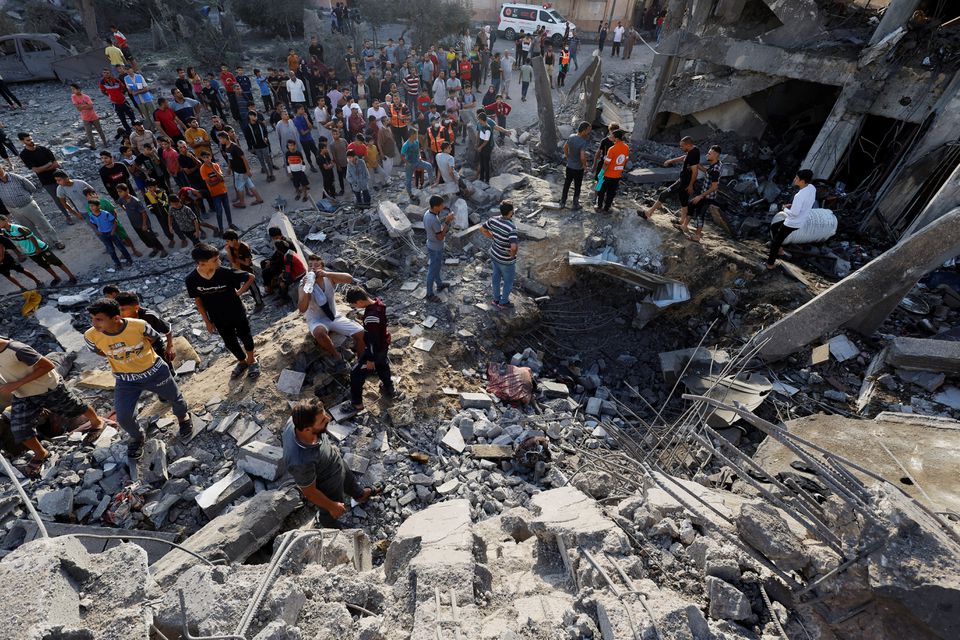
KHAN YOUNIS, Gaza Strip/CAIRO - Israeli troops fought their way back into an eastern section of Khan Younis in a surprise raid, residents said on Monday, sending people who had returned to abandoned homes in the ruins of the southern Gaza Strip's main city fleeing once more.
Elsewhere in Khan Younis, scores more bodies were recovered from what Palestinian authorities said were mass graves on the site of the city's main hospital, abandoned by Israeli troops. Further south there were fresh air strikes on Rafah, the last refuge where more than half of the enclave's 2.3 million people have sought shelter.
Israel abruptly pulled most of its ground troops out of the southern Gaza Strip this month after some of the most intense fighting of the seven-month-old war. Residents have begun making their way home to previously unaccessible neighbourhoods of what had been the enclave's second-biggest city, finding homes reduced to rubble and unrecovered dead in the streets.
"This morning many families who had left here in the past two weeks to go back home to Abassan came back. They were too frightened," Ahmed Rezik, 42, told Reuters from a school where he is sheltering in the western part of Khan Younis, referring to a district in the east.
"They said tanks pushed in the eastern area of the town under heavy fire, and they had to run for lives," he told Reuters via a chat app.
Israel launched its war in Gaza after fighters from the Hamas Islamist militant group that runs the enclave burst across the border fence on Oct. 7, killing 1,200 people and capturing more than 250 hostages, by Israeli tallies.
Israel responded by launching a ground assault on Gaza, vowing to annihilate Hamas. More than 34,000 people have since been confirmed killed according to Gaza health authorities, with thousands more bodies feared lost in the rubble.
'THE SCENE IS TOUGH'
In the ruins of what had been Nasser hospital, the biggest in southern Gaza, Reuters saw emergency workers in white hazmat suits digging corpses out of the ground with hand tools and a digger truck. The emergency services said 73 more bodies had been found at the site in the past day, raising the number found over the week to 283.
Israel says it was forced to battle inside hospitals because Hamas fighters operated there, which medical staff and Hamas deny.
Gaza authorities say the bodies recovered so far are from just one of at least three mass graves they have found at the site.
"We expect to find another 200 bodies at the same mass grave in the coming two days before we will begin working at the two other cemeteries," Ismail Al-Thawabta, director of the Hamas-run government media office, told Reuters.
He accused Israel of carrying out "executions" at the hospital and covering up the crimes by burying bodies with a bulldozer. Israel strongly denies having carried out executions.
Relatives have been coming to take away loved ones for reburial. Family members brought the body of Osama al-Shoubagy, one of those recovered inside the hospital grounds, to a graveyard on Monday to rebury him next to his sister, to whom he had once donated a kidney when she was sick.
"My young daughter asked me to visit the grave of her father. I would tell her that as soon as we bury him, we will visit him. Thank God. The scene is tough, but we might find some relief after burying him," said his wife Soumaya.
In one hand she held a few yellow flowers, in the other, the hand of their small daughter Hind, who wore a pale yellow Disney "Frozen" tracksuit to say goodbye to her father.
"He loved me, (and used to) buy things for me, and he used to take me out," the small girl said by the side of the new grave.
Gaza residents reported air strikes in several other areas, including Rafah, where a day earlier doctors had performed a caesarean section to save a baby from the womb of his mother who was among those killed.
In Nusseirat in central Gaza, officials said an air strike had damaged solar panels the hospital relies on for power.
Main News
Error: No articles to display
latest news
Europe
Asia
Nagasaki survivor accepts Nobel Peace Prize, calls for nuclear free world
IFAD, Nepal launch $120 million programme to help over 250,000 people
Embezzling property tycoon scrambles to raise $9bn to avoid death sentence
Pakistan: Everything we know about clashes between Imran Khan supporters and police
India: Mosque survey dispute erupts into deadly clashes
Taliban detained journalists over 250 times since takeover, UN
Philippines summons VP Duterte over threat to have Marcos killed
Four troops killed in Pakistan as protesters demand release of ex-PM Khan
Thousands of Imran Khan supporters defy arrest to head to capital
Pakistan sealing off capital ahead of planned rally by Imran Khan supporters
Fighting between armed sectarian groups in Pakistan kills at least 33 people
Rise in Afghan opium cultivation reflects economic hardship
Volcano erupts in Bali spewing five-mile ash cloud
New Delhi becomes world’s most polluted city as AQI levels reach 1,000
Pakistan’s toxic smog cover is now visible from space
Chinese driver 'angry about divorce settlement' ploughs into crowd leaving 35 dead
Taliban to attend UN climate conference for first time
Suicide bomber kills 24 in explosion at Pakistan train station
China unveils new heavy rocket that looks similar to SpaceX Starship
North Korea’s new ICBM missile records longest flight time yet
Japanese youth committed to fight poverty and hunger with IFAD
Japan's government in flux after election gives no party majority
Indan Muslims face discrimination after restaurants forced to display workers’ names
IFAD and Thailand sign agreement for new regional office in Bangkok
Nobel Peace Prize was awarded to the Japanese organization Nihon Hidankyo
Africa
DRC: Senior army officials must be investigated for possible crimes
Sudan: War Crimes in South Cordovan, HRW
Angola: US President Biden must demand immediate release of five critics
Wife of 'abducted' Ugandan opposition figure says he won't get justice
S.Africa opposition seeks to revive impeachment proceedings against Ramaphosa
Namibia may elect its first-ever female president in elections this week
Botswana turns to cannabis as diamonds are’s for ever
Influencers and social media beat mainstream media in Kenya
Mali’s ruling military appoints new prime minister
Regenerative Agriculture and Peace-building in South-central Somalia
Wits University unveils pan-African AI centre
'The UK will never forget Sudan,' says David Lammy
Sudan’s displaced have endured ‘unimaginable suffering, brutal atrocities’
Nearly half the world’s 1.1 billion poor live in conflict settings
Sudan war deaths are likely much higher than recorded
Africa’s mineral deposits can power the energy transition
The joint force of the AES ready to launch large-scale operations to secure Sahel
Mystery still surrounds death of revered UN chief Hammarskjöld, 63 years after plane crash
IFAD and Sierra Leone partner to boost farm productivity
Mozambique: End violent post-election crackdown ahead of 7 November Maputo march
Africa: Richer countries must commit to pay at COP29
Sudan’s ‘living nightmare’ continues as 11 million flee war
‘Alarming’ situation in Great Lakes Region of DR Congo
Climate change worsened rains in flood-hit African regions, scientists
African progress backslides as coups and war persist
Americas
Countering Collapse in Haiti
Malibu wildfires forced thousands to evacuate their homes
In Haiti, women suffer the consequences of gang violence
Pentagon announces $988 million Ukraine Security Assistance package
Trump says Russia, Iran in 'weakened state,' calls on Putin to make Ukraine deal
Musk dealt legal defeat in battle over $56 billion Tesla pay deal
Autonomous Systems Impact on Modern Warfare
US, Israel, China, and the Shifting Arms Trade in the Middle East
Support the Court, HRW
Private prisons in US stand to cash in from Trump’s mass deportation plan
G7 Foreign Ministers’ Meeting Statement
War Crimes Weapons: Made in the USA
Trump Cabinet and executive branch of different ideas and eclectic personalities
Trump Says He Will Impose 25% Tariff on Canada and Mexico on Day one
Prosecutors drop election interference and documents cases against Trump
Number of children recruited by gangs in Haiti soars by 70%, UNICEF
Archaeologists discover 4,000-year-old canals used to fish by predecessors of ancient Maya
Democrats in Congress urge Biden to sanction Israelis over West Bank violence
Susan Sarandon opens up on exile from Hollywood after PRO-Palestine remarks
What could Trump’s election win mean for Ukraine and the Middle East
Trump deploys garbage truck to trash Biden gaffe at Wisconsin rally
US calls on Israel to tackle ‘catastrophic humanitarian crisis’ in Gaza
Vinicius's Ballon d’Or snub sparks fury in Brazil amid claims of racism
CNN guest thrown off air after telling Mehdi Hasan:‘I hope your beeper doesn’t go off’
Pentagon warns North Korea as 10,000 troops set to join Russia’s war
Australia & Pacific
Australia passes world-first ban on social media for under 16s into law
New Zealanders save over 30 stranded whales by lifting them on sheets
Commonwealth leaders say 'time has come' for discussion on slavery reparations
Generational export reforms to boost AUKUS trade and collaboration
Australia lawmaker calls opposition leader racist over opposition to Gaza refugees
Agreement strengthens AUKUS submarine partnership
Passionate welcome for WikiLeaks founder Assange as he lands in Australia
Violent protests return to New Caledonia as pro-independence leader extradited
EU and Australia accelerate their digital cooperation
Over 2,000 people thought to have been buried alive in Papua New Guinea landslide
Over 670 people died in a massive Papua New Guinea landslide, UN
Macron says extra security to stay in riot-hit New Caledonia as long as needed
New Caledonia riots: Tourists evacuated, President Macron to visit
Hundreds more French police start deploying to secure New Caledonia
France declares state of emergency in New Caledonia as protests rage
Australia’s 2024 National Defence Strategy
Sydney rocked by second mass stabbing as knifeman attacks bishop
Three dead, 1,000 homes destroyed in Papua New Guinea quake
Australia and UK sign defense and security treaty
Australia tightens student visa rules as migration hits record high
Global food crisis and the effects of climate change need urgent action, IFAD
Indonesia, Australia to sign defence pact within months
Australia to ban doxxing after pro-Palestinians publish information about hundreds of Jews
Australia launches inquiry into why Cabinet documents relating to Iraq war remain secret
Australia says AI will help track Chinese submarines under new Aukus plan
MENA
Netanyahu describes corruption charges against him as ‘ocean of absurdity’ at trial
Israeli tanks '16 miles from Damascus' as overnight raids 'destroy Assad army's assets'
What’s happening in Syria? The key developments as Assad flees to Russia
Who is Abu Mohammed al-Golani, leader of insurgency that toppled Syria’s Assad?
Syrian leader Bashar Assad in Moscow, State news agency
IFAD and Kuwait agree to strengthen efforts to support small-scale farmers
Israel responds to Hezbollah rocket attack with airstrikes on south Lebanon
Egypt: Education Restricted for Refugee
At least 25 killed in counter air strikes by Syrian army on rebels in north-west
UNRWA suspends aid delivery to Gaza after lorries looted at gunpoint
Who are the Syrian rebels HTS and why are they advancing?
Syrian rebels capture centre of Aleppo in major blow to Assad regime
World Central Kitchen stops work in Gaza after three aid workers killed by Israeli strike
Lebanon must elect president during 60-day truce with Israel as part of ceasefire
Abbas clarifies PA presidency succession plan but experts unconvinced
At least 10 killed in Israeli air strike on Beit Lahia
UN calls for accountability and investigations in Israel-Hezbollah conflict
Saudi Arabia approves 2025 budget with estimated $315bn
Lebanon faces $25bn reconstruction bill after Israel-Hezbollah ceasefire
Israeli military to remain in Gaza for years, food minister says
Israeli government orders officials to boycott left-leaning paper Haaretz
In East Jerusalem, record number of homes destroyed to drive out Palestinian residents
Biden: Israel and Hezbollah Ceasefire deal can be blueprint to end Gaza war
Heavy rain and high waves wash away tents of Gaza's displaced
Saudi NEOM gigaproject a 'generational investment,' minister
Banners



Videos
-
Future of car-plane, see it to believe it
https://www.youtube.com/watch?v=D4uSWtazRCM
-
Mehdi Hasan: Islam is a peaceful religion
https://www.youtube.com/watch?v=Jy9tNyp03M0 -
Python swallows antelope whole in under an hour
https://www.youtube.com/watch?v=x0rk5zh7RaE
-
Sangoku dance
http://www.youtube.com/watch?v=Df1SkeiPEAo -
flying 3 kites wonder!
https://www.youtube.com/watch?v=nr9KrqN_lIg
-
Korea has talent
http://www.youtube.com/watch?v=tZ46Ot4_lLo&feature=related -
Paul Potts sings Nessun Dorma
http://www.youtube.com/watch?v=1k08yxu57NA
-
Susan Boyle - Britain's Got Talent
http://www.youtube.com/watch?v=RxPZh4AnWyk -
Twist and Pulse - Britain's Got Talent
http://www.youtube.com/watch?v=1RDiBxbT_CA -
Shaheen Jafargholi (HQ) Britain's Got Talent
http://www.youtube.com/watch?v=VYDM3MIzEHo
High-Quality clip of 12-year-old singer Shaheen Jafargholi auditioning on Britain's Got Talent 2009. First he sings Valerie by The Zutons, as performed by Amy Winehouse, but, after Simon interrupts him and asks for a different song, he just blew everyone away. -
David Calvo juggles and solves Rubik's Cubes
http://www.youtube.com/watch?v=lhkzgjOKeLs
-
Outdoor 'bubble pod' hotel unveiled
http://www.youtube.com/watch?v=9IPBKlWf-cA