
Home
Bobby Charlton joins ranks of football stars with dementia
- Details
- Written by northsouth
- Category: Sport
- Hits: 1235
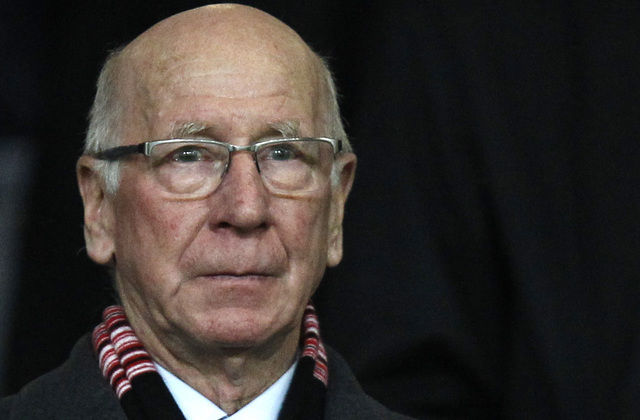
MANCHESTER, ENGLAND - Former Manchester United captain Steve Bruce has described Sir Bobby Charlton as "exemplary" after the England World Cup winner was diagnosed with dementia.
The Telegraph said that Charlton's wife, Lady Norma, was happy for the 83-year-old United and England great's condition to be reported.
The newspaper said Lady Norma had given the breaking of the news her "blessing", with the announcement coming two days after his club and country team-mate Nobby Stiles died after his own battle with the illness.
Newcastle boss Bruce, who spent almost a decade as a player at Old Trafford, described both Stiles and Charlton as "greats".
Bruce said: "I've had the privilege to have been in their company many, many times. The two of them are greats.
"The way they are as football players is one thing, but their humility, what they stood for, the way they were as individuals, Nobby and Sir Bobby were quite exemplary.
"All the advice they gave, you'd accept. In the 10 years nearly I was there at Manchester United, he came round, Sir Bobby did, every day and shook you by the hand.
"He came into the dressing room and that presence of, 'Wow! There's Sir Bobby Charlton, what a player he was'.
"I wish him well, and my thoughts also go to Nobby Stiles' family. We were all saddened by that news as well."
United boss Ole Gunnar Solskjaer also expressed his sadness over Stiles' death and the announcement of Charlton's condition.
"Of course it's sad news for everyone surrounding Man United and (who) are fans of Nobby," Solskjaer said after United's home defeat to Arsenal on Sunday.
"I had the pleasure of meeting him and what a humble man. It's sad and of course we as a club want to support Sir Bobby as well."
United and England forward Marcus Rashford gave his support to Charlton.
He wrote on Instagram: "I filmed alongside this man as a child and was in awe. I still am when I see you. This man, from day 1, was everything I wanted to be. Kind, professional, caring, talented.
"Sir Bobby, you are my hero and I am devastated that you are having to go through this. Stay strong, we love you".
In July, Charlton's brother Jack also died, himself having previously being diagnosed with dementia.
Sir Bobby Charlton is regarded as one of England's best ever, if not the best, footballers.
A 1966 World Cup winner, he held England's goalscoring record of 49 for close to 50 years until it was broken by Wayne Rooney. The same man would take his Manchester United scoring record when he passed the 249 goals he scored for his beloved Red Devils.
Gary Lineker, himself a scorer of 48 England goals, posted on Twitter: "Yet another hero of our 1966 World Cup winning team has been diagnosed with dementia. Perhaps the greatest of them all, @SirBobby. This is both very sad and deeply concerning."
Charlton's 249 Manchester United goals came across 758 games for the club, with his England total coming in 106 appearances and nearly all were from midfield.
A survivor of the Munich Air Disaster in 1958, he helped the rebuilding of the club in the wake of the tragedy and scored two goals as they beat Benfica to win the European Cup in 1968.
A statement from the club read: "Everyone at Manchester United is saddened that this terrible disease has afflicted Sir Bobby Charlton and we continue to offer our love and support to Sir Bobby and his family."
The Football Association also tweeted its best wishes.
The 10 countries that produce the most wheat
- Details
- Written by northsouth
- Category: Features
- Hits: 1441
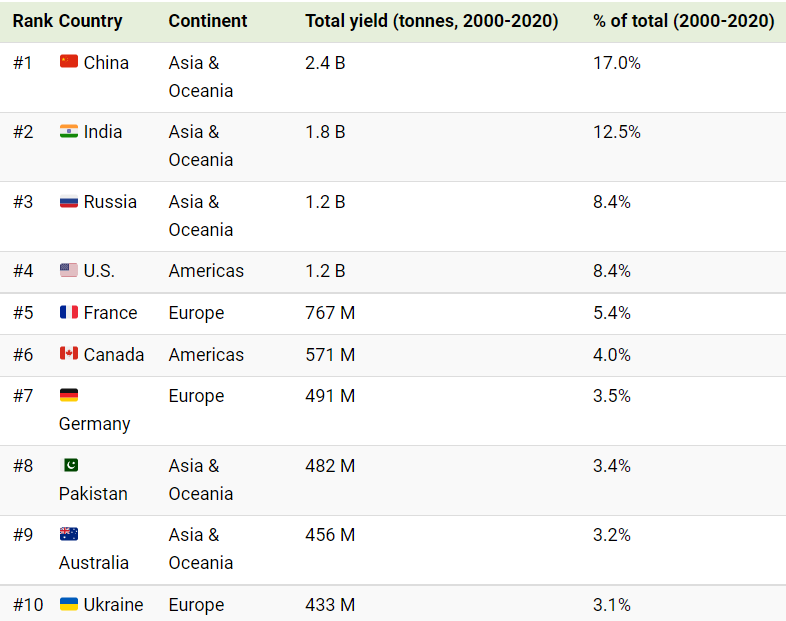
ROME - While more than 80 different countries produce wheat around the world, the majority of global wheat production comes from just a handful of countries, according to data from The Food and Agriculture Organization of the United Nations (FAO).
Here’s a look at the top 10 wheat-producing countries worldwide, based on total yield in tonnes from 2000-2020:
China, the world’s largest wheat producer, has yielded more than 2.4 billion tonnes of wheat over the last two decades, making up roughly 17% of total production from 2000-2020.
A majority of China’s wheat is used domestically to help meet the country’s rising food demand. China is the world’s largest consumer of wheat—in 2020/2021, the country accounted for approximately 19% of global wheat consumption.
The second-largest wheat-producing country is India. Over the last two decades, India has produced 12.5% of the world’s wheat. Like China, India keeps most of its wheat domestic because of significant food demand across the country.
Russia, the world’s third-largest wheat producer, is also the largest global exporter of wheat. The country exported more than $7.3 billion worth of wheat in 2021, accounting for approximately 13.1% of total wheat exports that year.
Russia-Ukraine Impact on Global Wheat Market
Because Russia and Ukraine are both significant global wheat producers, the ongoing conflict between the two countries has caused massive disruptions to the global wheat market.
The conflict has had an impact on adjacent industries as well. For instance, Russia is one of the world’s major fertilizer suppliers, and the conflict has led to a global fertilizer shortage which could lead to food shortages worldwide.
2021 Islamophobia in Review
- Details
- Written by northsouth
- Category: Features
- Hits: 1534
By Bridge Initiative Team, Washington DC, January 2022
WASHINGTON - Overall, 2021 demonstrated that Islamophobia remains a constant and growing threat around the globe. Anti-Muslim racism in 2021 remained ever present as hate crimes and individual attacks targeting Muslims persisted.
Across the globe, the key players of anti-Muslim racism were again states themselves, as this year witnessed increasing discriminatory legislation and policies.
China continued to deny the growing body of evidence pointing to genocide being committed against Uyghur Muslims and an international tribunal was held in the U.K. with testimony from survivors of Xinjiang’s concentration camps.
In Canada, a man killed a Muslim family of four in a horrific calculated hit-and-run, leading to Canadian Muslims demanding the government take concrete measures to tackle Islamophobic violence.
In France, President Emmanuel Macron’s government took a page from China’s book by implementing legislation aimed at constructing a state-approved Islam, resulting in widespread discrimination targeting Muslim civil society and curtailing the rights of French Muslims, especially women.
Similarly, the Austrian government took measures to intimidate and silence Austrian Muslim activists and organizations, even going so far as to publish a map detailing the locations of hundreds of mosques and associations. In the United Kingdom, the ruling Conservative party persisted in evading calls to address institutional Islamophobia within its ranks.
State hostility and prejudice towards Muslims was present across the European continent, with rulings aimed at restricting Muslim identity such as halal meat and hijab bans. In India, the country’s growing Hindu nationalist forces retained last year’s theme of conspiracy theories, claiming Indian Muslims were engaging in “love jihad,” “economic jihad,” and even “narcotics jihad.”
Additionally, there were large episodes of anti-Muslim violence in various parts of the country such as Tripura, Gurgaon, and Assam, all of which were supported by the rising Hindu nationalist voices. The year was also spent uncovering the role of social media platforms in larger campaigns of violence targeting Muslims as seen in India and Myanmar.
In the United States, the country marked twenty years since the deadly September 11th attacks and reckoned with the impacts and consequences of two decades of the War on Terror at home and abroad.
2021 demonstrated that Islamophobia remains a constant and growing threat around the globe. Anti-Muslim racism in 2021 remained ever present as hate crimes and individual attacks targeting Muslims persisted. Across the globe, the key players of anti-Muslim racism were again states themselves, as this year witnessed increasing discriminatory legislation and policies.
ARTICLES:
United States: With the inauguration of Joe Biden as the country’s 46th president, American Muslims welcomed the new administration and celebrated as Biden reversed Trump’s Muslim Ban. While applauding the measure, many noted that a reversal would not bring back the time and lives lost as a result of the previous discriminatory measure, and called on Biden to use this moment to tackle the presence of anti-Muslim racism in society, calling for accountability and justice.
India: Throughout 2021, Indian Muslims found themselves on the receiving end of countless mob attacks and state violence as Prime Minister Narendra Modi’s government continued to embolden the country’s right-wing Hindu nationalist forces. Further, conspiracy theories constructing Indian Muslims as a threat to the Hindu majoritarian population gained credibility thanks to the rhetoric and actions of politicians and the government.
The right-ward shift in the subcontinent also led many commentators and experts in the region to fear that Modi’s rule was leading to a decay in the world’s largest democracy as journalists critical of the government were targeted and imprisoned and counter-terror legislation was used to silence critics. In a testament to increasing state hostility, even elite actors and actresses of India’s Bollywood were not immune to the Hindu nationalist government’s assault on free speech.
China: In 2021, the world heard more personal testimonies from Uyghurs who had survived China’s network of concentration camps as a growing international movement called on countries to boycott the 2022 Beijing Winter Olympics. This year also involved Chinese authorities restructuring their targeting of Uyghurs, moving many prisoners to forced labor camps and institutionalizing discriminatory practices, such as removing domes from mosques, aimed at erasing Uyghur culture and identity.
Growing calls from activists and rights organizations for action from the international community also contributed to an unofficial tribunal held in the UK, which found that the People’s Republic of China (PRC) is committing genocide, a conclusion made by a number of countries this year including the Canadian parliament, MPs in the UK, Dutch parliament, and the Lithuanian parliament.
China’s campaign targeting Uyghurs goes back decades and must be understood in the settler-colonial context of the region. However, following 9/11 and the introduction of the war on terror discourse, Chinese authorities adopted this rhetoric framing Uyghur Muslims as a security threat to the state and began slowly criminalizing various aspect of Uyghur culture and identity, all under the banner of tackling the “three evil forces” of separatism, extremism, and terrorism. The establishment of concentration camps, dubbed “re-education” centers by the Chinese Communist Party (CCP), in 2017 and the projected growth of these fortresses of torture and psychological manipulation is just one aspect of China’s wider campaign in the occupied Uyghur homeland (which Chinese authorities refer to as Xinjiang).
In 2021, the world heard more harrowing stories from survivors of China’s crackdown in the region: a project involving torture, rape, detention, indoctrination, and psychological abuse.
Europe: In 2021, Islamophobia in Europe was further institutionalized within policies and programs that effectively criminalized Muslim civil society on the continent. In France, President Emmanuel Macron introduced the anti-Separatism law restricting the rights of French Muslim citizens and essentially forcing Muslims religious leader to take an oath of loyalty. Meanwhile in Switzerland, the government approved a ban on the burqa, adding to the growing number of countries that have restricted Muslim women’s right to religious freedom.
The trend on the continent has been to construct Europe’s Muslims as both a security and cultural threat, using arguments framed under counterterrorism and secularism to justify discriminatory and harmful rhetoric and practices that have severely curtailed the basic rights of Muslims.
In a review of 2021, Austrian academic and Bridge Senior Researcher Farid Hafez described the Europe’s right-ward shift as the continent entering an age of “McCarthyism against Islam,” with government policies framing Muslim citizenry as potential threats, suspicious, and ultimately untrustworthy. With the current status quo, it appears that “guilty until proven innocent increasingly becomes authorities’ approach to Muslims,” and Hafez demonstrated this by highlighting France, Austria, and Denmark’s collective approach to fighting “political Islam.”
In neighboring France, President Emmanuel Macron solidified his presidency as one marked by state-led Islamophobia, where under his leadership the government instituted measures that stigmatized and collectively punished France’s nearly 6 million Muslims. Much like Austria, Macron’s government hinged on the “political Islam” boogeyman to justify measures that not only severely curtailed the rights of Muslims but many argued also was an attack on French secularism. In late 2020, under the guise of fighting “political Islam,” Macron gave Muslim religious leaders an ultimatum, essentially forcing Imams to sign a charter or otherwise be considered a threat and enemy to the state. In March 2021, a coalition of civil society organizations urged the European Commission to investigate France at the European Court of Justice over the charter, saying that it “violates Muslims’ right to free speech and religious freedoms.”
In 2020, Macron also introduced the anti-separtism bill, which was approved by Members of Parliament in February 2021 and adopted by the National Assembly on July 23, 2021.
French legal scholar Rim-Sarah Alouane described the bill as an “attack” on civil liberties, stating, “I see a blatant attack on freedom of association. This bill has no safeguards of potential abuse from public authorities,” and further noted that “French Muslims are paying the price of the failure of the state to prevent terrorist attacks from happening.” Further the bill also included measures aimed at increasing restrictions on Muslim women’s ability to wear the hijab, with the argument of religious neutrality used to extend the hijab ban to private companies under contract with the state.
In January 2021, a coalition of thirty-six organizations from thirteen countries submitted a twenty-eight-page document to the United Nations Human Rights Commission (UNHRC), calling on the international body to “open formal infringement procedures against France’s government for entrenching Islamophobia and structural discrimination against Muslims.” The organizations alleged that under Macron’s governance, France’s recent “actions and policies in relation to Muslim communities violated international and European laws.”
Many critics noted that these actions were being taken by the government to play on the ongoing culture wars, and to silence any group or individual who called out the government’s Islamophobia, by linking anyone on the left with “‘Islamism,’ the eternal bogeyman in French society.”
The measures aimed at dismantling French Muslim civil society remained in force as a French court confirmed the dissolution of the Collective Against Islamophobia in France (CCIF), a leading anti-discrimination group that tracked Islamophobia in the country. Adding to this, in 2021 the government shut down a Muslim publishing house. In October 2021, Interior Minister Gerard Darmanin announced the government would close 7 more mosques and associations in the country by the end of the year, and stated that since Macron had taken office, “some 13 associations have been closed along with 92 of the 2,500 mosques in the country.” Under the pretense of tackling “radicalization” and “political Islam,” the French government has taken measures to dismantle Muslim civil society and strike fear in the French Muslim community.
Experts, commentators, and writers all noted how the current political climate in France involved a surge in the far-right and an overall massive shift right-ward in the country. Given the upcoming 2022 presidential elections, it appears that candidates in the running to lead the country are attempting to outdo each other when it comes to blatant anti-Muslim bigotry.
In 2021, Europe continued on a right-ward path as anti-Muslim racism became the norm in media, politics, and society. While some political leaders dragged their feet in addressing the issue of Islamophobia, many others openly incorporated dangerous and discriminatory anti-Muslim rhetoric into their agenda.
Canada: In July of 2021, Mustafa Farooq of the National Council of Canadian Muslims (NCCM) made a chilling observation: “The reality is that Canada has suffered more mass killings motivated by Islamophobia in the last five years than any other country in the G7. This cannot be allowed to continue.” Farooq’s comments came a little over a month after a deadly targeted hit-and-run in London, Ontario that killed four members of a Canadian Muslim family, with the sole survivor being a 9-year-old boy. The incident sent shockwaves across the country, and Canadian Muslims called on the government to take greater action against rising anti-Muslim hatred in the country beginning with tackling bigoted rhetoric and support for discriminatory policies amongst those in power.
2021 Year in Review: Celebrating UN values in action
- Details
- Written by northsouth
- Category: Features
- Hits: 1236
THE UNITED NATIONS - Conflict, health crises and the climate emergency may have dominated headlines this year but, behind the scenes, countless unsung heroes were working tirelessly to put the values of the UN into action. Here are some of the inspiring personal stories we featured on our UN News pages during 2021.
As the COVID-19 pandemic continued into a second year, many of the exceptional people we featured in 2021 were, unsurprisingly, health workers putting themselves at considerable personal risk to ensure members of their communities survived the pandemic.
‘We pray to God to save us from famine’
These risks are compounded in conflict zones where workers continue to provide health services against great odds.
In Yemen, Asia El-Sayeed Ali and her family had to flee their home in Aden and move in with relatives. Today, she works at a health clinic supported by the World Food Programme (WFP), where she cares for children, and their mothers, suffering from malnutrition.
“When a mother brings in a child suffering from malnutrition, I provide nutrition treatment, and advise her to bring them back the following week”, says Ms. El-Sayeed Ali. “When she returns, and I see the child has gained weight, and is looking healthier with filled out cheeks, I feel relieved.
“I love working in the clinic. My heart aches when I see children crying from pain or hunger, but I can make a positive difference, helping the mothers, and put a smile on the face of the children.”
Staying to help the Afghan people
In Afghanistan, following the take-over by the Taliban, Dr Khali Ahmadi* told UN News in an exclusive interview from the Afghan capital Kabul in August, that he and other healthcare workers are continuing to work despite the lack of security and ongoing instability in the country and called on the international community to carry on supporting Afghanistan.
Dr. Ahmadi was in Kabul to provide health care for the thousands of people who had streamed into the city to escape fighting. “Our workday is very long and hard”, he told us. “I start at around 7am and can sometimes work until midnight which means, as a team, we can treat up to 500 people a day.
Sometimes, the security situation means I will stay at home. If there are reports of gunfire or other disturbances as well as roadblocks, the team members decide is too dangerous to work. It can be very tense on the streets.”
‘I thought about my own children’
Throughout the year, UN News spoke to many other people choosing to work in countries where the security risk is high. Among them was Fezeh Rezaye, a 26-year-old mother of two, and a member of a 19-strong, all-female demining team, honoured in April for their efforts to rid the Afghan province of Afghanistan of mines.
“I had known several people from my village who have been injured or killed by mines in Bamyan” she recounted. “Even our landlord lost his leg in a landmine accident. But it was the death of seven children, all from the same family in our village, that really affected me.
“They had been together in the mountains when they were all killed by a mine explosion. I thought about my own children, that this could have happened to them.”
I have to be on my A-game’
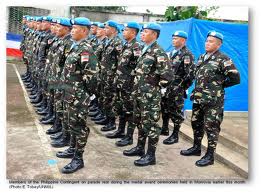
For the soldiers, or ‘blue helmets’, who are part of the UN peacekeeping mission in Mali - for some years now, the most dangerous UN posting in the world - every patrol could be their last.
Trooper Jack Drake, a young soldier from the UK, is a driver with a military reconnaissance team tasked with protecting civilians in trouble spots in northeastern Mali. “I really have to focus on picking the best route for the vehicle and knowing when to put my foot down to avoid getting stuck”, he explained.
“Mali is a dangerous place right now, so I really have to be on my A-game on patrol. It’s important to recognize any threats and stay switched on the whole time. You rely on the other members of your crew to stay safe.”
‘Peacekeeping is a human enterprise’
Since being deployed in the Darfur region of Sudan in 2019, Kenyan Military Gender Advisor, Major Steplyne Nyaboga, has worked diligently to promote the rights of women and girls, organizing campaigns and workshops for staff and civil society activists.
In recognition of the excellence of her work, the UN awarded Major Nyaboga with the 2020 UN Military Gender Advocate of the Year Award. “Peacekeeping is a human enterprise”, she responded. “Placing women and girls at the centre of our efforts and concerns, will help us better protect civilians and build a more sustainable peace”.
Major Nyaboga took charge of gender education for other military peacekeepers during her deployment, training nearly 95 per cent of UNAMID’s military contingent by December of last year. She also advised the force on how to better identify the needs of vulnerable men, women, boys and girls, and improve the way the peacekeepers protected them.
Championing the Earth
In the year that the postponed COP26 in Glasgow, the most important UN climate conference since Paris in 2015, finally took place following a pandemic-related postponement, the climate crisis and the work of grassroots activists gained added attention.
From August until the end of October, the UN featured 10 young activists, engineers, and entrepreneurs, showing how we can all make a positive change, in our hit podcast series, No Denying It.
The change-makers include Nzambi Matee, a Kenyan entrepreneur who makes sustainable low-cost construction materials made of recycled plastic waste and sand. Her company, Gjenge Makers, has financially empowered over 112 individuals, through the supply and pre-processing stages of the production process.
Greek activist Lefteris Arapakis founded the first fishing school in his country, and has convinced fishermen to haul in plastic from the ocean. In this episode of No Denying It, Mr. Arapakis explains that he founded the school after hearing from his fisherman father that, despite Greece’s economic crisis, there was a lack of labour for fishing boats.
Thanks to the school’s initiatives, fish stocks and the ecosystem are recovering, plastic waste has been returned to the circular economy, and fishermen in his community have an added source of income.
Many of the activists featured in No Denying It have been identified as Young Champions of the Earth by the UN Environment Programme (UNEP) which announced its latest Champions in December.
This year’s cohort, all women, include Prime Minister Mia Mottley of Barbados, who was honoured for being a powerful voice from the global south, arguing for a sustainable world and consistently raising the alarm about the vulnerability of Small Island Developing States.
The fight for rights
Human rights of all kinds continued to come under attack in 2021, and many brave individuals fought back to protect them.
UN News shone a light on the 30-year struggle of Brazilian activist Joenia Wapixana to secure land rights for the country’s indigenous population in Brazil.
In 2018, at the end of a long campaign, financed at the grassroots level by crowdfunding, she became the first indigenous woman elected to Brazil’s federal parliament and was awarded the UN Human Rights Prize
In a special interview, Ms. Wapixana called for more resources for the fight against institutionalized discrimination. “Society needs to understand that discrimination against the indigenous has always existed in Brazil”, she explained.
“I believe that when a person has suffered racial discrimination, or is suffering from racism, it is necessary to protect them with the fullest extent of the law. Report the incident, even if nothing comes of it. It is important for us to create a record of this phase that we are going through.”
‘Poverty is both the cause and the consequence of disability’
Eddie Ndopu, an award-winning disability activist from South Africa, lives with spinal muscular atrophy, and faces many dailychallenges. Now in his late 20s, Mr. Ndopu says that his parents were told at his birth that he would not live beyond the age of five.
Mr. Ndopu told the UN that he has overcome his barriers to travel the world advocating for others with disabilities. “Poverty is both the cause and the consequence of disability, and the overwhelming majority of people with disabilities live in poverty, he says in an interview, taken from an episode of the UN’s Awake at Night podcast.
“I think we don't talk about disability because we insist on perfection. And I think disability reminds people that actually, imperfection is more intrinsic to all of us than perfection.”
Main News
Error: No articles to display
latest news
- New blood test can spot breast cancer at earliest stages, scientists
- Sole bidders Saudi Arabia confirmed as hosts of 2034 men’s World Cup
- Nagasaki survivor accepts Nobel Peace Prize, calls for nuclear free world
- Countering Collapse in Haiti
- Crude oil price and production movements, OPEC
- IFAD, Nepal launch $120 million programme to help over 250,000 people
- DiEM25 challenges EU’s inhumane practices towards migrants
- Malibu wildfires forced thousands to evacuate their homes
- DRC: Senior army officials must be investigated for possible crimes
- Netanyahu describes corruption charges against him as ‘ocean of absurdity’ at trial
- Authorities disrupt migrant smuggling supply chain
- Israeli tanks '16 miles from Damascus' as overnight raids 'destroy Assad army's assets'
- In Haiti, women suffer the consequences of gang violence
- ICC arrest warrants for top Israeli officials are step toward justice
- Poland: Brutal Pushbacks at Belarus Border
- Sudan: War Crimes in South Cordovan, HRW
- Europeans politicians quick to promote hate against Syrian refugees
- Pentagon announces $988 million Ukraine Security Assistance package
- Trump says Russia, Iran in 'weakened state,' calls on Putin to make Ukraine deal
- $1.7 billion in airline funds blocked by governments
- 12 Ways to improve circulation for healthy blood flow, Doctors
- Action against ‘phone phishing’ gang in Belgium, Netherlands: 8 arrests
- $282 million program targeting agriculture and food systems
- What’s happening in Syria? The key developments as Assad flees to Russia
- UK nearly as divided as the US, report finds
Europe
DiEM25 challenges EU’s inhumane practices towards migrants
Authorities disrupt migrant smuggling supply chain
ICC arrest warrants for top Israeli officials are step toward justice
Poland: Brutal Pushbacks at Belarus Border
Europeans politicians quick to promote hate against Syrian refugees
Action against ‘phone phishing’ gang in Belgium, Netherlands: 8 arrests
UK nearly as divided as the US, report finds
Starmer rejects choice between EU and US allies
French government at risk of collapsing over 2025 budget
Belgium convicted of crimes against humanity for acts committed during colonisation
23rd International Economic Forum on Africa Monday 9 December
Putin Approves New Budget With Record Defence Spending
UK MPs back Assisted dying bill after emotionally-charged Commons debate
Ireland goes to polls with three parties neck and neck
Putin full of praise for ‘intelligent and experienced’ Trump
UK to continue selling arms to Israel despite Lebanon ceasefire, Starmer says
Crackdown on illegal streaming network with 22 million users worldwide
France says Israel's Netanyahu has immunity from ICC arrest warrant
Number of Europeans diagnosed with HIV rose in 2023 with new cases in most countries
Georgian prime minister suspends EU membership talks until end of 2028
Russian missile fired at Ukraine carried warheads without explosives
Russia advances in Ukraine at fastest monthly pace since start of war
Why are news outlets not covering crackdown on pro-Palestinian journalists in UK?
Starmer and Lammy are ‘monstrous war criminals’, Palestinian lawyer
Storm Bert brings severe flooding across UK
Asia
Nagasaki survivor accepts Nobel Peace Prize, calls for nuclear free world
IFAD, Nepal launch $120 million programme to help over 250,000 people
Embezzling property tycoon scrambles to raise $9bn to avoid death sentence
Pakistan: Everything we know about clashes between Imran Khan supporters and police
India: Mosque survey dispute erupts into deadly clashes
Taliban detained journalists over 250 times since takeover, UN
Philippines summons VP Duterte over threat to have Marcos killed
Four troops killed in Pakistan as protesters demand release of ex-PM Khan
Thousands of Imran Khan supporters defy arrest to head to capital
Pakistan sealing off capital ahead of planned rally by Imran Khan supporters
Fighting between armed sectarian groups in Pakistan kills at least 33 people
Rise in Afghan opium cultivation reflects economic hardship
Volcano erupts in Bali spewing five-mile ash cloud
New Delhi becomes world’s most polluted city as AQI levels reach 1,000
Pakistan’s toxic smog cover is now visible from space
Chinese driver 'angry about divorce settlement' ploughs into crowd leaving 35 dead
Taliban to attend UN climate conference for first time
Suicide bomber kills 24 in explosion at Pakistan train station
China unveils new heavy rocket that looks similar to SpaceX Starship
North Korea’s new ICBM missile records longest flight time yet
Japanese youth committed to fight poverty and hunger with IFAD
Japan's government in flux after election gives no party majority
Indan Muslims face discrimination after restaurants forced to display workers’ names
IFAD and Thailand sign agreement for new regional office in Bangkok
Nobel Peace Prize was awarded to the Japanese organization Nihon Hidankyo
Africa
DRC: Senior army officials must be investigated for possible crimes
Sudan: War Crimes in South Cordovan, HRW
Angola: US President Biden must demand immediate release of five critics
Wife of 'abducted' Ugandan opposition figure says he won't get justice
S.Africa opposition seeks to revive impeachment proceedings against Ramaphosa
Namibia may elect its first-ever female president in elections this week
Botswana turns to cannabis as diamonds are’s for ever
Influencers and social media beat mainstream media in Kenya
Mali’s ruling military appoints new prime minister
Regenerative Agriculture and Peace-building in South-central Somalia
Wits University unveils pan-African AI centre
'The UK will never forget Sudan,' says David Lammy
Sudan’s displaced have endured ‘unimaginable suffering, brutal atrocities’
Nearly half the world’s 1.1 billion poor live in conflict settings
Sudan war deaths are likely much higher than recorded
Africa’s mineral deposits can power the energy transition
The joint force of the AES ready to launch large-scale operations to secure Sahel
Mystery still surrounds death of revered UN chief Hammarskjöld, 63 years after plane crash
IFAD and Sierra Leone partner to boost farm productivity
Mozambique: End violent post-election crackdown ahead of 7 November Maputo march
Africa: Richer countries must commit to pay at COP29
Sudan’s ‘living nightmare’ continues as 11 million flee war
‘Alarming’ situation in Great Lakes Region of DR Congo
Climate change worsened rains in flood-hit African regions, scientists
African progress backslides as coups and war persist
Americas
Countering Collapse in Haiti
Malibu wildfires forced thousands to evacuate their homes
In Haiti, women suffer the consequences of gang violence
Pentagon announces $988 million Ukraine Security Assistance package
Trump says Russia, Iran in 'weakened state,' calls on Putin to make Ukraine deal
Musk dealt legal defeat in battle over $56 billion Tesla pay deal
Autonomous Systems Impact on Modern Warfare
US, Israel, China, and the Shifting Arms Trade in the Middle East
Support the Court, HRW
Private prisons in US stand to cash in from Trump’s mass deportation plan
G7 Foreign Ministers’ Meeting Statement
War Crimes Weapons: Made in the USA
Trump Cabinet and executive branch of different ideas and eclectic personalities
Trump Says He Will Impose 25% Tariff on Canada and Mexico on Day one
Prosecutors drop election interference and documents cases against Trump
Number of children recruited by gangs in Haiti soars by 70%, UNICEF
Archaeologists discover 4,000-year-old canals used to fish by predecessors of ancient Maya
Democrats in Congress urge Biden to sanction Israelis over West Bank violence
Susan Sarandon opens up on exile from Hollywood after PRO-Palestine remarks
What could Trump’s election win mean for Ukraine and the Middle East
Trump deploys garbage truck to trash Biden gaffe at Wisconsin rally
US calls on Israel to tackle ‘catastrophic humanitarian crisis’ in Gaza
Vinicius's Ballon d’Or snub sparks fury in Brazil amid claims of racism
CNN guest thrown off air after telling Mehdi Hasan:‘I hope your beeper doesn’t go off’
Pentagon warns North Korea as 10,000 troops set to join Russia’s war
Australia & Pacific
Australia passes world-first ban on social media for under 16s into law
New Zealanders save over 30 stranded whales by lifting them on sheets
Commonwealth leaders say 'time has come' for discussion on slavery reparations
Generational export reforms to boost AUKUS trade and collaboration
Australia lawmaker calls opposition leader racist over opposition to Gaza refugees
Agreement strengthens AUKUS submarine partnership
Passionate welcome for WikiLeaks founder Assange as he lands in Australia
Violent protests return to New Caledonia as pro-independence leader extradited
EU and Australia accelerate their digital cooperation
Over 2,000 people thought to have been buried alive in Papua New Guinea landslide
Over 670 people died in a massive Papua New Guinea landslide, UN
Macron says extra security to stay in riot-hit New Caledonia as long as needed
New Caledonia riots: Tourists evacuated, President Macron to visit
Hundreds more French police start deploying to secure New Caledonia
France declares state of emergency in New Caledonia as protests rage
Australia’s 2024 National Defence Strategy
Sydney rocked by second mass stabbing as knifeman attacks bishop
Three dead, 1,000 homes destroyed in Papua New Guinea quake
Australia and UK sign defense and security treaty
Australia tightens student visa rules as migration hits record high
Global food crisis and the effects of climate change need urgent action, IFAD
Indonesia, Australia to sign defence pact within months
Australia to ban doxxing after pro-Palestinians publish information about hundreds of Jews
Australia launches inquiry into why Cabinet documents relating to Iraq war remain secret
Australia says AI will help track Chinese submarines under new Aukus plan
MENA
Netanyahu describes corruption charges against him as ‘ocean of absurdity’ at trial
Israeli tanks '16 miles from Damascus' as overnight raids 'destroy Assad army's assets'
What’s happening in Syria? The key developments as Assad flees to Russia
Who is Abu Mohammed al-Golani, leader of insurgency that toppled Syria’s Assad?
Syrian leader Bashar Assad in Moscow, State news agency
IFAD and Kuwait agree to strengthen efforts to support small-scale farmers
Israel responds to Hezbollah rocket attack with airstrikes on south Lebanon
Egypt: Education Restricted for Refugee
At least 25 killed in counter air strikes by Syrian army on rebels in north-west
UNRWA suspends aid delivery to Gaza after lorries looted at gunpoint
Who are the Syrian rebels HTS and why are they advancing?
Syrian rebels capture centre of Aleppo in major blow to Assad regime
World Central Kitchen stops work in Gaza after three aid workers killed by Israeli strike
Lebanon must elect president during 60-day truce with Israel as part of ceasefire
Abbas clarifies PA presidency succession plan but experts unconvinced
At least 10 killed in Israeli air strike on Beit Lahia
UN calls for accountability and investigations in Israel-Hezbollah conflict
Saudi Arabia approves 2025 budget with estimated $315bn
Lebanon faces $25bn reconstruction bill after Israel-Hezbollah ceasefire
Israeli military to remain in Gaza for years, food minister says
Israeli government orders officials to boycott left-leaning paper Haaretz
In East Jerusalem, record number of homes destroyed to drive out Palestinian residents
Biden: Israel and Hezbollah Ceasefire deal can be blueprint to end Gaza war
Heavy rain and high waves wash away tents of Gaza's displaced
Saudi NEOM gigaproject a 'generational investment,' minister
Banners



Videos
-
Future of car-plane, see it to believe it
https://www.youtube.com/watch?v=D4uSWtazRCM
-
Mehdi Hasan: Islam is a peaceful religion
https://www.youtube.com/watch?v=Jy9tNyp03M0 -
Python swallows antelope whole in under an hour
https://www.youtube.com/watch?v=x0rk5zh7RaE
-
Sangoku dance
http://www.youtube.com/watch?v=Df1SkeiPEAo -
flying 3 kites wonder!
https://www.youtube.com/watch?v=nr9KrqN_lIg
-
Korea has talent
http://www.youtube.com/watch?v=tZ46Ot4_lLo&feature=related -
Paul Potts sings Nessun Dorma
http://www.youtube.com/watch?v=1k08yxu57NA
-
Susan Boyle - Britain's Got Talent
http://www.youtube.com/watch?v=RxPZh4AnWyk -
Twist and Pulse - Britain's Got Talent
http://www.youtube.com/watch?v=1RDiBxbT_CA -
Shaheen Jafargholi (HQ) Britain's Got Talent
http://www.youtube.com/watch?v=VYDM3MIzEHo
High-Quality clip of 12-year-old singer Shaheen Jafargholi auditioning on Britain's Got Talent 2009. First he sings Valerie by The Zutons, as performed by Amy Winehouse, but, after Simon interrupts him and asks for a different song, he just blew everyone away. -
David Calvo juggles and solves Rubik's Cubes
http://www.youtube.com/watch?v=lhkzgjOKeLs
-
Outdoor 'bubble pod' hotel unveiled
http://www.youtube.com/watch?v=9IPBKlWf-cA