
Home
Thousands displaced in Rafah and Israel's military offensive continues
- Details
- Written by Super User
- Category: MENA
- Hits: 578
BY HARRIET SINCLAIR
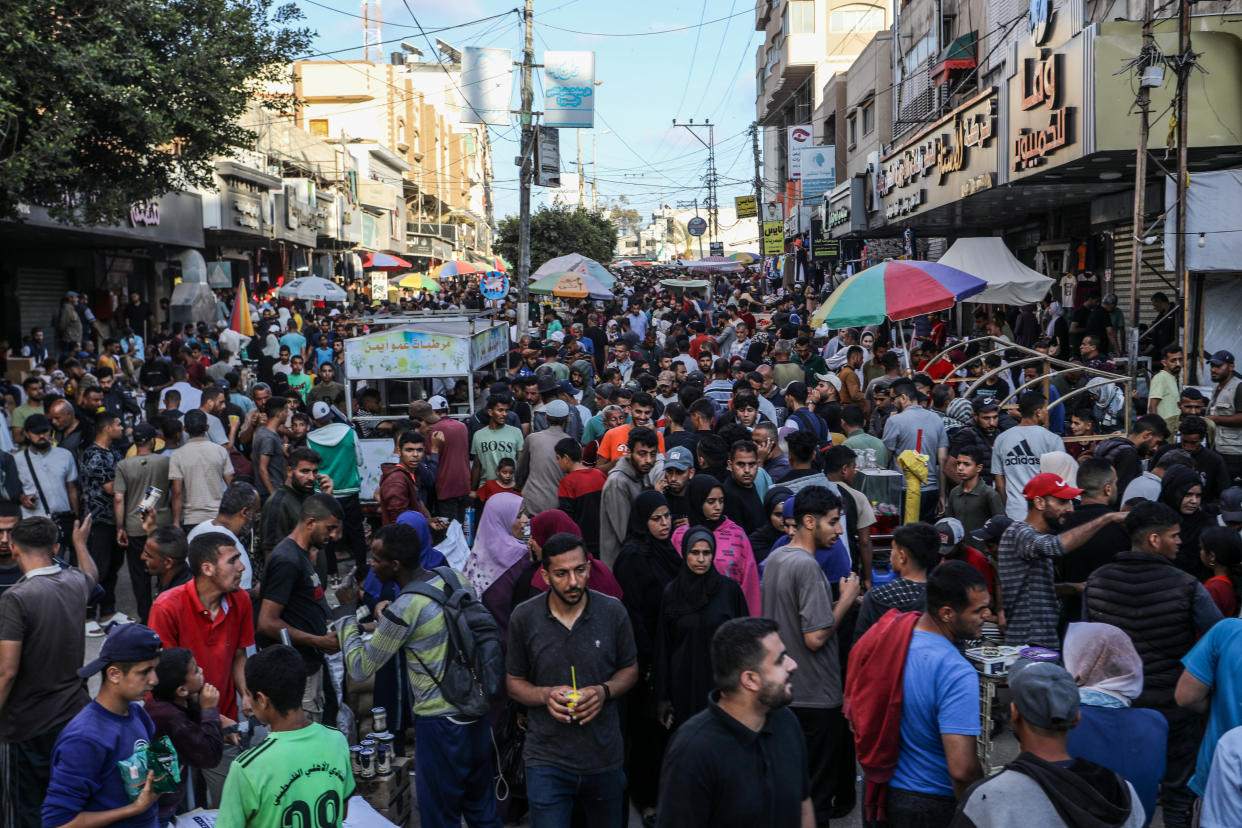
RAFAH, Occupied Gaza - The southern Gaza city of Rafah has been under siege since Israel forces began what it described as “targeted” ground operations on 6 May.
Once a safe zone for Gazans fleeing conflict in other areas of the enclave, Rafah's expanded population of 1.5 million people (of whom around 1.25 million people were displaced from elsewhere in Gaza) has dwindled to 500,000 – with one million having fled bombardment in the past three weeks.
Israel says Hamas' remaining battalions are in Rafah, and its May offensive in the city has seen Israel gain control of 75% of the zone along the Gaza-Egypt border, a senior Israeli official told the BBC.
Israeli bombings of tented encampments in recent days have resulted in the deaths of at least 65 displaced people, according to the Hamas-run health ministry, while Israel has also seized control of (and closed) the vital Rafah crossing, through which much-needed aid was previously delivered to Gaza.
Charities have warned of a humanitarian catastrophe unfolding, with food, medicine and water now in desperately short supply.
The last hospital in Rafah is also under threat, with aid workers warning that a continuing Israeli incursion would likely see healthcare in the city grind to a total halt.
"If the incursion would continue, we would lose the last hospital in Rafah," Richard Peeperkorn, the World Health Organization (WHO) representative for Gaza and the West Bank, told Reuters.
Rafah is the southernmost city in the Gaza Strip, and the final refuge for many Palestinians who have been displaced multiple times during Israel's bombardment.
Prior to Israel's current offensive in the city, more than 1.3 million people were taking refuge in Rafah, having been displaced from other areas of Gaza.
It became one of the most densely populated places in the world as more Gazans were forced there, with Medical Aid for Palestinians at one point warning that overcrowding had "forced many displaced people to sleep on the streets, in the grounds of hospitals, or in makeshift tents in schools". Of the three hospitals in Rafah, just one remains "barely functional", the WHO said this week.
Prior to the expected ground invasion, Rafah was still subject to airstrikes by the Israel Defense Force, despite the area being designated by Israel as a "safe zone" for people to flee to while northern Gaza was bombarded.
Rafah is a particularly important location given its proximity to the Rafah Border Crossing with Egypt, through which humanitarian aid has previously been delivered.
Timeline of recent events in Rafah
6 May 2024
After weeks of speculation about increased military action in Rafah, Israel drops leaflets in the city ordering people to evacuate.
7 May 2024
Israel seizes control of the Gazan side of the Rafah border crossing, telling civilians in eastern Rafah to evacuate. Israeli airstrikes hit the city, killing at least 25 people.
Aid through the vital crossing is halted – both Israel and Egypt blame one another for the crossing being closed.
8 May 2024
US president Joe Biden urges Israel against the military action, and says the US will not supply weapons that could be used in a Rafah offensive. Israeli airstrikes in Rafah kill at least 12 people, according to data from OCHA ReliefWeb.
9 May 2024
Hamas fires at IDF troops as they continue raids in the city. Israeli airstrikes continue, killing at least eight people in Rafah.
Amnesty International warns that thousands of people in Rafah will be killed if ground operations continue. “Nowhere in Gaza can currently provide aid at a scale that will ensure people’s survival,” it told Al Jazeera. “If the planned ground operation is not stopped, thousands more civilians will be killed.”
10 May 2024
UN agencies warn that aid in Gaza is rapidly dwindling following the closure of the Rafah Crossing. The number of people who have fled Rafah now sits at 280,000, according to a UN tally, with half of those people fleeing in the past day.
“For five days, no fuel and virtually no humanitarian aid entered the Gaza Strip, and we are scraping the bottom of the barrel,” Unicef senior emergency coordinator in the Gaza strip, Hamish Young, told The Guardian.
11 May 2024
The IDF steps up its operation in Rafah. A UN official in western Rafah tells the BBC: "We've had a significant increase in bombardment and it's definitely advancing towards us."
Israel says Hamas has fired rockets at the Rafah crossing and also reports face-to-face battles with Hamas in areas of the city.
13 May 2024
Gaza authorities warn the health system is at risk of imminent collapse, as a result of the limited aid available following the closing of the Rafah crossing.
More than 900 parents of Israeli soldiers sign a letter calling for Israeli PM Benjamin Netanyahu to call off the "reckless" Rafah offensive, which they said was a "deadly trap" for their children.
14 May 2024
Medicins Sans Fronteirs (MSF) says it left Rafah Indonesian field hospital on Sunday. A UN worker describes the inland of the city as a "ghost town" as people continue to flee. Officials estimate that up to 500,000 people have now evacuated from the city.
Israeli tanks continue further into eastern Rafah, according to local reports.
15 May 2024
Israeli tanks push into built-up areas of Rafah. The UN estimates 600,000 people have now fled the city.
Netanyahu defends Israel's Rafah operation, saying: "The humanitarian catastrophe that has been spoken of has not been realised, nor will it."
Tent cities spring up outside of Rafah, as displaced people are forced to move once again to areas outside of the city.
17 May 2024
Israel's counsel tells the International Court of Justice (ICJ), which is hearing South Africa's case to force Israel to stop the Rafah offensive: "Only by bringing down Hamas's military stronghold in Rafah will Palestinians be liberated from the clenched grip of the murderous terrorist regime and the road to peace and prosperity may finally be paved."
18 May 2024
At least 800,000 people have now fled Rafah, according to UNRWA commissioner-general Philippe Lazzarini.
Israel says it has recovered the bodies of hostages Ron Binyamin, Shani Louk, Itzhak Gelerenter and Amit Buskila, who were killed by Hamas in the 7 October attacks. Israel says intelligence suggests other hostages are being held in Rafah.
The IDF says it is increasing humanitarian aid in Gaza. The Rafah crossing remains closed.
21 May 2024
At least five people are killed in airstrikes in Rafah, including three children, Reuters reports.
UNRWA suspends food distribution in Rafah due to lack of supplies.
24 May 2024
The International Court of Justice (ICJ) orders Israel to stop its military offensive in Rafah. However the order is not enforceable.
26 May 2024
An Israeli airstrike on displaced people in tents kills at least 45 people, according to the Gaza Ministry of Health. The situation is later described by UNRWA as "hell on earth".
Israel's military said its attack was on a “compound of the terrorist organisation Hamas in Rafah, where key terrorists of the organisation were staying”.
In the aftermath of the bombing, images show people combing through the charred remains of the camp, searching for the bodies of family members and friends.
27 May
Netanyahu says the tent bombing in Rafah was a "tragic mistake". Addressing parliament, he said Israel would be investigating.
28 May 2024
The Hamas-run health ministry says 21 more people have been killed in another airstrike on displaced people in tents, and a further 64 injured. The IDF says it did not strike the camp at Al-Mawasi,
Around one million people have now fled the city.
Israeli spy chief ‘threatened’ ICC prosecutor over war crimes inquiry
- Details
- Written by Super User
- Category: MENA
- Hits: 499
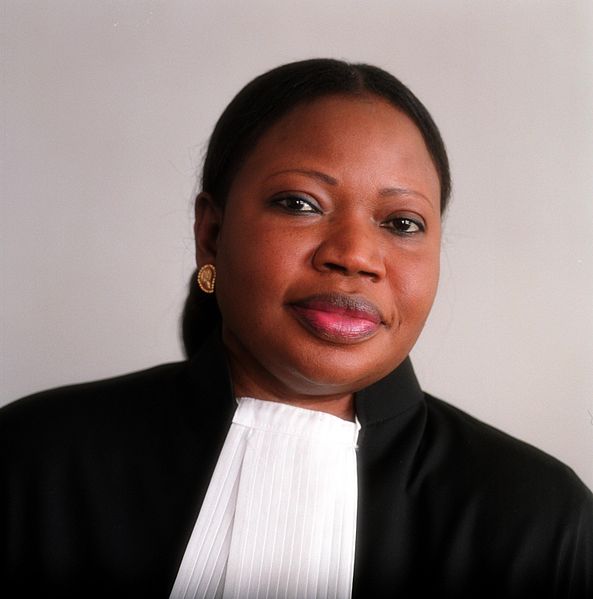
LONDON - The former head of the Mossad, Israel’s foreign intelligence agency, allegedly threatened a chief prosecutor of the international criminal court in a series of secret meetings in which he tried to pressure her into abandoning a war crimes investigation, the London-based Guardian can reveal.
Yossi Cohen’s covert contacts with the ICC’s then prosecutor, Fatou Bensouda, took place in the years leading up to her decision to open a formal investigation into alleged war crimes and crimes against humanity in occupied Palestinian territories.
That investigation, launched in 2021, culminated last week when Bensouda’s successor, Karim Khan, announced that he was seeking an arrest warrant for the Israeli prime minister, Benjamin Netanyahu, over the country’s conduct in its war in Gaza.
The prosecutor’s decision to apply to the ICC’s pre-trial chamber for arrest warrants for Netanyahu and his defence minister, Yoav Gallant, alongside three Hamas leaders, is an outcome Israel’s military and political establishment has long feared.
Cohen’s personal involvement in the operation against the ICC took place when he was the director of the Mossad. His activities were authorised at a high level and justified on the basis the court posed a threat of prosecutions against military personnel, according to a senior Israeli official.
Another Israeli source briefed on the operation against Bensouda said the Mossad’s objective was to compromise the prosecutor or enlist her as someone who would cooperate with Israel’s demands.
A third source familiar with the operation said Cohen was acting as Netanyahu’s “unofficial messenger”.
Cohen, who was one of Netanyahu’s closest allies at the time and is emerging as a political force in his own right in Israel, personally led the Mossad’s involvement in an almost decade-long campaign by the country to undermine the court.
Four sources confirmed that Bensouda had briefed a small group of senior ICC officials about Cohen’s attempts to sway her, amid concerns about the increasingly persistent and threatening nature of his behaviour.
Three of those sources were familiar with Bensouda’s formal disclosures to the ICC about the matter. They said she revealed Cohen had put pressure on her on several occasions not to proceed with a criminal investigation in the ICC’s Palestine case.
According to accounts shared with ICC officials, he is alleged to have told her: “You should help us and let us take care of you. You don’t want to be getting into things that could compromise your security or that of your family.”
One individual briefed on Cohen’s activities said he had used “despicable tactics” against Bensouda as part of an ultimately unsuccessful effort to intimidate and influence her. They likened his behaviour to “stalking”.
The Mossad also took a keen interest in Bensouda’s family members and obtained transcripts of secret recordings of her husband, according to two sources with direct knowledge of the situation. Israeli officials then attempted to use the material to discredit the prosecutor.
The revelations about Cohen’s operation form part of a forthcoming investigation by the Guardian, the Israeli-Palestinian publication +972 Magazine and the Hebrew-language outlet Local Call, revealing how multiple Israel intelligence agencies ran a covert “war” against the ICC for almost a decade.
Contacted by the Guardian, a spokesperson for Israel’s prime minister’s office said: “The questions forwarded to us are replete with many false and unfounded allegations meant to hurt the state of Israel.” Cohen did not respond to a request for comment. Bensouda declined to comment.
In the Mossad’s efforts to influence Bensouda, Israel received support from an unlikely ally: Joseph Kabila, the former president of the Democratic Republic of the Congo, who played a supporting role in the plot.
Revelations about the Mossad’s efforts to influence Bensouda come as the current chief prosecutor, Khan, warned in recent days that he would not hesitate to prosecute “attempts to impede, intimidate or improperly influence” ICC officials.
According to legal experts and former ICC officials, efforts by the Mossad to threaten or put pressure on Bensouda could amount to offences against the administration of justice under article 70 of the Rome statute, the treaty that established the court.
A spokesperson for the ICC would not to say whether Khan had reviewed his predecessor’s disclosures about her contacts with Cohen, but said Khan had never met or spoken to the head of the Mossad.
While the spokesperson declined to comment on specific allegations, they said Khan’s office had been subjected to “several forms of threats and communications that could be viewed as attempts to unduly influence its activities”.
Bensouda sparks ire of Israel
Khan’s decision to seek arrest warrants against Netanyahu and Gallant last week marked the first time the court had taken action against leaders of a country closely allied with the US and Europe. Their alleged crimes – which include directing attacks on civilians and using starvation as a method of warfare – relate to the eight-month war in Gaza.
The ICC case, however, dates back to 2015, when Bensouda decided to open a preliminary examination into the situation in Palestine. Short of a full investigation, her inquiry was tasked with making an initial assessment of allegations of crimes by individuals in Gaza, the West Bank and East Jerusalem.
Bensouda’s decision sparked the ire of Israel, which feared its citizens could be prosecuted for their involvement in operations in Palestinian territories. Israel had long been open about its opposition to the ICC, refusing to recognise its authority. Israeli ministers intensified their attacks on the court and even vowed to try to dismantle it.
Soon after commencing the preliminary examination, Bensouda and her senior prosecutors began to receive warnings that Israeli intelligence was taking a close interest in their work.
According to two sources, there were even suspicions among senior ICC officials that Israel had cultivated sources within the court’s prosecution division, known as the office of the prosecutor. Another later recalled that although the Mossad “didn’t leave its signature”, it was an assumption the agency was behind some of the activity officials had been made aware of.
Only a small group of senior figures at the ICC, however, were informed that the director of the Mossad had personally approached the chief prosecutor.
A career spy, Cohen enjoys a reputation in Israel’s intelligence community as an effective recruiter of foreign agents. He was a loyal and powerful ally of the prime minister at the time, having been appointed as director of the Mossad by Netanyahu in 2016 after working for several years at his side as his national security adviser.
As the head of the national security council between 2013 and 2016, Cohen oversaw the body that, according to multiple sources, began to coordinate a multiagency effort against the ICC once Bensouda opened the preliminary inquiry in 2015.
Cohen’s first interaction with Bensouda appears to have taken place at the Munich security conference in 2017, when the Mossad director introduced himself to the prosecutor in a brief exchange. After this encounter, Cohen subsequently “ambushed” Bensouda in a bizarre episode in a Manhattan hotel suite, according to multiple sources familiar with the incident.
Bensouda was in New York in 2018 on an official visit, and was meeting Kabila, then the president of the DRC, at his hotel. The pair had met several times before in relation to the ICC’s ongoing investigation into alleged crimes committed in his country.
The meeting, however, appears to have been a setup. At a certain point, after Bensouda’s staff were asked to leave the room, Cohen entered, according to three sources familiar with the meeting. The surprise appearance, they said, caused alarm to Bensouda and a group of ICC officials travelling with her.
Why Kabila helped Cohen is unclear, but ties between the two men were revealed in 2022 by the Israeli publication TheMarker, which reported on a series of secretive trips the Mossad director made to the DRC throughout 2019.
According to the publication, Cohen’s trips, during which he sought Kabila’s advice “on an issue of interest to Israel”, and which were almost certainly approved by Netanyahu, were highly unusual and had astonished senior figures within the intelligence community.
Reporting on the DRC meetings in 2022, the Israeli broadcaster Kan 11 said Cohen’s trips related to an “extremely controversial plan” and cited official sources who described it as “one of Israel’s most sensitive secrets”.
Multiple sources have confirmed to the Guardian the trips were partly related to the ICC operation, and Kabila, who left office in January 2019, played an important supporting role in the Mossad’s plot against Bensouda. Kabila did not respond to a request for comment.
‘Threats and manipulation’
After the surprise meeting with Kabila and Bensouda in New York, Cohen repeatedly phoned the chief prosecutor and sought meetings with her, three sources recalled. According to two people familiar with the situation, at one stage Bensouda asked Cohen how he had obtained her phone number, to which he replied: “Did you forget what I do for a living?”
Initially, the sources explained, the intelligence chief “tried to build a relationship” with the prosecutor and played “good cop” in an attempt to charm her. The initial objective, they said, appeared to have been to enlist Bensouda into cooperating with Israel.
Over time, however, the tone of Cohen’s contact changed and he began to use a range of tactics, including “threats and manipulation”, an individual briefed on the meetings said. This prompted Bensouda to inform a small group of senior ICC officials about his behaviour.
In December 2019, the prosecutor announced that she had grounds to open a full criminal investigation into allegations of war crimes in Gaza, the West Bank and East Jerusalem. However, she held off launching it, deciding first to request a ruling from the ICC’s pre-trial chamber to confirm the court did indeed have jurisdiction over Palestine.
Multiple sources said it was at this stage, as the judges considered the case, that Cohen escalated his attempts to persuade Bensouda not to pursue a full investigation in the event the judges gave her the green light.
Between late 2019 and early 2021, the sources said, there were at least three encounters between Cohen and Bensouda, all initiated by the spy chief. His behaviour is said to have become increasingly concerning to ICC officials.
A source familiar with Bensouda’s accounts of the final two meetings with Cohen said he had raised questions about her security, and that of her family, in a manner that led her to believe he was threatening her.
On one occasion, Cohen is said to have shown Bensouda copies of photographs of her husband, which were taken covertly when the couple were visiting London. On another, according to sources, Cohen suggested to the prosecutor that a decision to open a full investigation would be detrimental to her career.
Four sources familiar with the situation said it was around the same time that Bensouda and other ICC officials discovered that information was circulating among diplomatic channels relating to her husband, who worked as an international affairs consultant.
Between 2019 and 2020, the Mossad had been actively seeking compromising information on the prosecutor and took an interest in her family members.
The spy agency obtained a cache of material, including transcripts of an apparent sting operation against her husband.
It is unclear who conducted the operation, or precisely what he is alleged to have said in the recordings. One possibility is that he had been targeted by the intelligence agency or by private actors of another country that wanted leverage over the ICC. Another possibility is the information was fabricated.
Once in the possession of Israel, however, the material was used by its diplomats in an unsuccessful attempt to undermine the chief prosecutor. But according to multiple sources, Israel failed to convince its allies of the significance of the material.
Three sources briefed on the information shared by Israel at a diplomatic level described the efforts as part of an unsuccessful “smear campaign” against Bensouda. “They went after Fatou,” one source said, but it had “no impact” on the prosecutor’s work.
The diplomatic efforts were part of a coordinated effort by the governments of Netanyahu and Donald Trump in the US to place public and private pressure on the prosecutor and her staff.
Between 2019 and 2020, in an unprecedented decision, the Trump administration imposed visa restrictions and sanctions on the chief prosecutor. The move was in retaliation to Bensouda’s pursuit of a separate investigation into war crimes in Afghanistan, allegedly committed by the Taliban and both Afghan and US military personnel.
However, Mike Pompeo, then US secretary of state, linked the sanctions package to the Palestine case. “It’s clear the ICC is only putting Israel in [its] crosshairs for nakedly political purposes,” he said.
Months later, he accused Bensouda, without citing any evidence, of having “engaged in corrupt acts for her personal benefit”.
The US sanctions were rescinded after President Joe Biden entered the White House.
In February 2021, the ICC’s pre-trial chamber issued a ruling confirming the ICC had jurisdiction in occupied Palestinian territories. The following month, Bensouda announced the opening of the criminal investigation.
“In the end, our central concern must be for the victims of crimes, both Palestinian and Israeli, arising from the long cycle of violence and insecurity that has caused deep suffering and despair on all sides,” she said at the time.
Bensouda completed her nine-year term at the ICC three months later, leaving it to her successor, Khan, to take up the investigation. It was only after the Hamas attacks on Israel on 7 October and the ensuing war on Gaza that the ICC’s investigation gained renewed urgency, culminating in last week’s request for arrest warrants.
It was the conclusion Israel’s political, military and intelligence establishment had feared. “The fact they chose the head of Mossad to be the prime minister’s unofficial messenger to [Bensouda] was to intimidate, by definition,” said a source briefed on Cohen’s operation. “It failed.”
At least 50 dead from Israeli strikes on Gaza after Hamas launches rockets at Tel Aviv
- Details
- Written by Super User
- Category: MENA
- Hits: 532
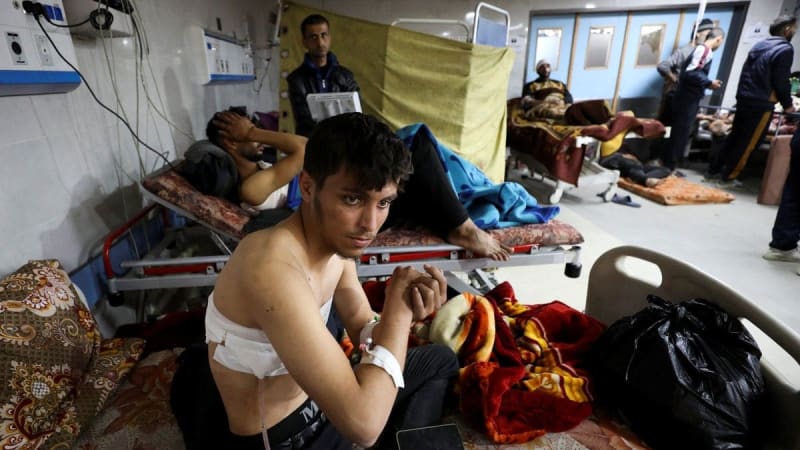
OCCUPIED GAZA STRIP - At least 50 people were killed and dozens more were injured by an Israeli airstrike on Rafah city in southern Gaza, Palestinian authorities have said.
The health ministry said that most of those killed and injured in Rafah had been women and children, in an area where thousands of people had been taking shelter after being instructed to take refuge in the southern region of the besieged enclave.“Numerous others were trapped in flaming debris,” said the officials.
The attacks came two days after the International Court of Justice ordered Israel to end its military offensive in Rafah, where more than half of Gaza‘s 2.3 million population had sought shelter before Israel’s incursion earlier this month. Tens of thousands of people remain in the area while many others have fled.
Confirming the assault, Israeli military said its air force struck a Hamas compound and that the strike was carried with “precise ammunition and on the basis of precise intelligence”.
It added: “The IDF is aware of reports indicating that as a result of the strike and fire that was ignited several civilians in the area were harmed. The incident is under review.”
Graphic footage from the scene shared by the Gaza health ministry showed widespread destruction.The International Committee of the Red Cross said its field hospital in Rafah was receiving an influx of casualties, and that other hospitals also were taking in a large number of patients.
Senior Hamas official Sami Abu Zuhri described the attack in Rafah as a “massacre”, holding the United States responsible for aiding Israel with weapons and money.
“The air strikes burnt the tents, the tents are melting and the people’s bodies are also melting,” said one of the residents who arrived at the Kuwaiti hospital in Rafah.
A spokesperson with the Palestinian Red Crescent Society said the death toll was likely to rise as search and rescue efforts continued in Rafah’s Tal al-Sultan neighbourhood, about 2km northwest of the city centre. It said the target of the strike was part of what Israel had designated as a “humanitarian area” and had not been subject to Israeli evacuation orders earlier this month.
The charity ActionAid said its activists witnessed the attack, which it described as an “inhumane and barbaric act”. “We are outraged and heartbroken by the recent attacks in West Rafah, where Israeli fighter jets launched eight missiles at makeshift shelters housing internally displaced persons (IDPs) next to UNRWA warehouses stocking vital aid,” the charity said in a statement.
“These shelters were supposed to be safe havens for innocent civilians, yet they became targets of brutal violence. Children, women, and men are being burned alive under their tents and shelters.”
Earlier on Sunday, the Israeli military said eight projectiles were identified crossing from the area of Rafah, the southern tip of the Gaza Strip, setting off air raid sirens as far away as Tel Aviv. There were no reports of casualties in what appeared to be the first long-range rocket attack from Gaza since January.
Israel’s military said eight projectiles crossed into Israel after being launched from Rafah and “a number” were intercepted, and the launcher was destroyed. Hamas’ military wing claimed responsibility for the rocket attack.
Prime minister Benjamin Netanyahu was convening his war cabinet later on Sunday to discuss continued operations in Rafah. Israel argues the UN court’s ruling allows room for some military action there.
In a statement on its Telegram channel, the Hamas al-Qassam Brigades said the rockets were launched in response to “Zionist massacres against civilians”.
Israel says it wants to root out Hamas fighters holed up in Rafah and rescue hostages it says are being held in the area, but its assault has worsened the plight of civilians and caused an international outcry.
On Sunday, Israeli strikes killed at least five Palestinians in Rafah, according to local medical services. The Gaza health ministry identified the dead as civilians.
Israeli tanks have probed around the edges of Rafah near the crossing point from Gaza into Egypt, and residents say they have entered some of its eastern districts, but have not yet entered the city in force since the start of operations in the city earlier this month.
Israeli war cabinet minister Benny Gantz said the rockets fired from Rafah “prove that the [IDF] must operate in every place Hamas still operates from”.
Defence minister Yoav Gallant held an operational assessment in Rafah where he was briefed on “troops’ operations above and below the ground, as well as the deepening of operations in additional areas with the aim of dismantling Hamas battalions”, his office said in a statement.
Itamar Ben Gvir, a hardline public security minister who is not part of Israel’s war cabinet, urged the army to hit Rafah harder. “Rafah with full force,” he posted on X.
Nearly 36,000 Palestinians have been killed in Israel’s offensive, Gaza’s health ministry says. Israel launched the operation after Hamas-led militants attacked southern Israeli communities on October 7, killing around 1,200 people and seizing more than 250 hostages, according to Israeli tallies.
Earlier on Sunday, dozens of aid trucks entered Gaza from southern Israel under a new agreement to bypass the Rafah crossing with Egypt after Israeli forces seized the Palestinian side of it earlier this month. Israel’s military said 126 aid trucks entered via the nearby Kerem Shalom crossing.
But it was not immediately clear if humanitarian groups could access the aid — including medical supplies — because of fighting. The crossing has been largely inaccessible because of Israel’s offensive in Rafah. United Nations agencies say it is usually too dangerous to retrieve the aid. The World Health Organization last week said an expanded Israeli incursion in Rafah would have “disastrous” impact.”
“With the humanitarian operation near collapse, the secretary-general emphasizes that the Israeli authorities must facilitate the safe pickup and delivery of humanitarian supplies from Egypt entering Kerem Shalom,” the spokesperson for UN chief Antonio Guterres said in a statement.
Egypt refuses to reopen its side of the Rafah crossing until control of the Gaza side is handed back to Palestinians. It agreed to temporarily divert traffic through Kerem Shalom, Gaza‘s main cargo terminal, after a call between US president Joe Biden and Egyptian president Abdel Fattah el-Sissi.
With Hamas holding firm and fighting back in Gaza, Israel faces only bad options
- Details
- Written by Super User
- Category: MENA
- Hits: 482

JERUSALEM — Diminished but not deterred, Hamas is still putting up a fight after seven brutal months of war with Israel, regrouping in some of the hardest-hit areas in northern Gaza and resuming rocket attacks into nearby Israeli communities.
Israel initially made tactical advances against Hamas after a devastating aerial bombardment paved the way for its ground troops. But those early gains have given way to a grinding struggle against an adaptable insurgency — and a growing feeling among many Israelis that their military faces only bad options, drawing comparisons with U.S. wars in Iraq and Afghanistan.
This was the subtext of a rebellion in recent days by two members of Prime Minister Benjamin Netanyahu’s three-man War Cabinet — Defense Minister Yoav Gallant and Benny Gantz, Netanyahu’s main political rival — who demanded that he come up with detailed postwar plans.
They supported Israel’s retaliation for Hamas’ Oct. 7 attack, including one of the heaviest bombing campaigns in recent history, ground operations that obliterated entire neighborhoods and border restrictions that the U.N.'s World Food Program says pushed parts of the territory into famine.
But now the two retired generals fear a prolonged, costly re-occupation of Gaza, from which Israel withdrew soldiers and settlers in 2005. They are also opposed to a withdrawal that would leave Hamas in control or lead to the establishment of a Palestinian state.
Instead, they have put forth alternatives that many Israelis see as wildly unrealistic. Hamas, meanwhile, has proposed its own postwar plan.
Here’s a look at four ways this war might end.
FULL-SCALE MILITARY OCCUPATION
Netanyahu has promised a “total victory” that would remove Hamas from power, dismantle its military capabilities and return the scores of hostages it still holds from the attack that triggered the war.
He has said victory could come within weeks if Israel launches a full-scale invasion of Rafah, which Israel portrays as the last Hamas stronghold.
Amir Avivi, a retired Israeli general and former deputy commander of the Gaza division, says that’s only the beginning. He said Israel would need to remain in control to prevent Hamas from regrouping.
“If you don’t drain the swamp, you cannot deal with the mosquitoes. And drain the swamp means a complete change in the education system, and dealing with local leadership and not with a terror organization,” he said. “This is a generational process. It’s not going to happen in a day.”
Far-right members of Netanyahu’s governing coalition, who hold the key to his remaining in power, have called for permanent occupation, “voluntary emigration” of large numbers of Palestinians to anywhere that will have them, and rebuilding of Jewish settlements in Gaza.
Most Israelis are opposed, pointing to the immense costs of stationing thousands of troops in the territory that is home to 2.3 million Palestinians. As an occupying power, Israel would likely be held responsible for providing health, education and other services. It’s unclear to what extent international donors would step in to fund reconstruction amid ongoing hostilities.
There’s also no guarantee such an occupation would eliminate Hamas.
Israel was in full control of Gaza when Hamas was established in the late 1980s. Israel’s 18-year occupation of southern Lebanon coincided with the rise of Hezbollah, and Israeli troops routinely battle militants in the West Bank, which it has controlled since 1967.
A LIGHTER OCCUPATION, AIDED BY ‘UNICORNS’
Netanyahu has said Israel will maintain security control over Gaza but delegate civilian administration to local Palestinians unaffiliated with Hamas or the Western-backed Palestinian Authority, which governs parts of the occupied West Bank. He has suggested that Arab and other countries assist with governance and rebuilding.
But so far, none have shown interest.
No Palestinians are known to have offered to cooperate with the Israeli military, perhaps because Hamas has said they would be treated as collaborators, a veiled death threat.
Efforts to reach out to Palestinian businessmen and powerful families “have ended in catastrophe,” says Michael Milshtein, an Israeli analyst of Palestinian affairs at Tel Aviv University and a former military intelligence officer.
He says Israelis seeking such allies are searching for “unicorns” — something that does not exist.
Arab states have also roundly rejected this scenario — even the United Arab Emirates, which is one of the few to formally recognize Israel and has close ties with it.
“The UAE refuses to be involved in any plan aimed at providing cover for the Israeli presence in the Gaza Strip,” Foreign Minister Abdullah bin Zayed Al Nahyan said this month.
A GRAND BARGAIN
Instead, Arab states have coalesced around a U.S. proposal aimed at resolving the decades-old conflict and transforming the Middle East.
Under this plan, a reformed Palestinian Authority would govern Gaza with the assistance of Arab and Muslim nations, including Saudi Arabia, which would normalize relations with Israel in return for a U.S. defense pact and help in building a civilian nuclear program.
But U.S. and Saudi officials say that hinges on Israel committing to a credible path to eventual Palestinian statehood.
Netanyahu has ruled out such a scenario — as have Gallant and Gantz — saying it would reward Hamas and result in a militant-run state on Israel’s borders.
Palestinians say ending Israel’s decades-long occupation and creating a fully independent state in Gaza, the West Bank and east Jerusalem — territories Israel captured in the 1967 Mideast war — is the only way to end the cycle of bloodshed.
Hamas has said it would accept a two-state solution on at least an interim basis, but its political program still calls for the “full liberation of Palestine,” including what is now Israel. Hamas has also said it must be part of any postwar settlement.
A DEAL WITH HAMAS
Hamas has proposed a very different grand bargain — one that, ironically enough, might be more palatable to Israelis than the U.S.-Saudi deal.
The militant group has proposed a phased agreement in which it would release all of the hostages in return for hundreds of Palestinian prisoners — including senior militants — as well as the withdrawal of Israeli forces from Gaza, a lengthy cease-fire and reconstruction.
That would almost certainly leave Hamas in control of Gaza and potentially allow it to rebuild its military capabilities. Hamas might even claim victory, despite the extensive death and destruction suffered by Palestinian civilians since Oct. 7.
But thousands of Israeli protesters have taken to the streets in recent weeks calling on their leaders to take such a deal, because it’s probably the only way to get the hostages back.
They accuse Netanyahu of standing in the way of such an agreement because it could lead his far-right allies to bring down his government, potentially ending his political career and exposing him to prosecution on corruption charges.
Supporters of such a deal say there would be other benefits for Israel, beyond freeing the hostages.
The low-intensity conflict with Lebanon’s Hezbollah would likely die down as regional tensions ease, allowing tens of thousands of people on both sides of the border to return to their homes. Israel could finally reckon with the security failures that led to Oct. 7.
And it could prepare for another inevitable round of fighting.
Milshtein says Israel should adopt Hamas’ concept of a “hudna” — a prolonged period of strategic calm.
“Hudna doesn’t mean a peace agreement,” he said. “It’s a cease-fire that you will exploit in order to make yourself stronger and then to attack and surprise your enemy.”
Main News
Error: No articles to display
latest news
- New blood test can spot breast cancer at earliest stages, scientists
- Sole bidders Saudi Arabia confirmed as hosts of 2034 men’s World Cup
- Nagasaki survivor accepts Nobel Peace Prize, calls for nuclear free world
- Countering Collapse in Haiti
- Crude oil price and production movements, OPEC
- IFAD, Nepal launch $120 million programme to help over 250,000 people
- DiEM25 challenges EU’s inhumane practices towards migrants
- Malibu wildfires forced thousands to evacuate their homes
- DRC: Senior army officials must be investigated for possible crimes
- Netanyahu describes corruption charges against him as ‘ocean of absurdity’ at trial
- Authorities disrupt migrant smuggling supply chain
- Israeli tanks '16 miles from Damascus' as overnight raids 'destroy Assad army's assets'
- In Haiti, women suffer the consequences of gang violence
- ICC arrest warrants for top Israeli officials are step toward justice
- Poland: Brutal Pushbacks at Belarus Border
- Sudan: War Crimes in South Cordovan, HRW
- Europeans politicians quick to promote hate against Syrian refugees
- Pentagon announces $988 million Ukraine Security Assistance package
- Trump says Russia, Iran in 'weakened state,' calls on Putin to make Ukraine deal
- $1.7 billion in airline funds blocked by governments
- 12 Ways to improve circulation for healthy blood flow, Doctors
- Action against ‘phone phishing’ gang in Belgium, Netherlands: 8 arrests
- $282 million program targeting agriculture and food systems
- What’s happening in Syria? The key developments as Assad flees to Russia
- UK nearly as divided as the US, report finds
Europe
DiEM25 challenges EU’s inhumane practices towards migrants
Authorities disrupt migrant smuggling supply chain
ICC arrest warrants for top Israeli officials are step toward justice
Poland: Brutal Pushbacks at Belarus Border
Europeans politicians quick to promote hate against Syrian refugees
Action against ‘phone phishing’ gang in Belgium, Netherlands: 8 arrests
UK nearly as divided as the US, report finds
Starmer rejects choice between EU and US allies
French government at risk of collapsing over 2025 budget
Belgium convicted of crimes against humanity for acts committed during colonisation
23rd International Economic Forum on Africa Monday 9 December
Putin Approves New Budget With Record Defence Spending
UK MPs back Assisted dying bill after emotionally-charged Commons debate
Ireland goes to polls with three parties neck and neck
Putin full of praise for ‘intelligent and experienced’ Trump
UK to continue selling arms to Israel despite Lebanon ceasefire, Starmer says
Crackdown on illegal streaming network with 22 million users worldwide
France says Israel's Netanyahu has immunity from ICC arrest warrant
Number of Europeans diagnosed with HIV rose in 2023 with new cases in most countries
Georgian prime minister suspends EU membership talks until end of 2028
Russian missile fired at Ukraine carried warheads without explosives
Russia advances in Ukraine at fastest monthly pace since start of war
Why are news outlets not covering crackdown on pro-Palestinian journalists in UK?
Starmer and Lammy are ‘monstrous war criminals’, Palestinian lawyer
Storm Bert brings severe flooding across UK
Asia
Nagasaki survivor accepts Nobel Peace Prize, calls for nuclear free world
IFAD, Nepal launch $120 million programme to help over 250,000 people
Embezzling property tycoon scrambles to raise $9bn to avoid death sentence
Pakistan: Everything we know about clashes between Imran Khan supporters and police
India: Mosque survey dispute erupts into deadly clashes
Taliban detained journalists over 250 times since takeover, UN
Philippines summons VP Duterte over threat to have Marcos killed
Four troops killed in Pakistan as protesters demand release of ex-PM Khan
Thousands of Imran Khan supporters defy arrest to head to capital
Pakistan sealing off capital ahead of planned rally by Imran Khan supporters
Fighting between armed sectarian groups in Pakistan kills at least 33 people
Rise in Afghan opium cultivation reflects economic hardship
Volcano erupts in Bali spewing five-mile ash cloud
New Delhi becomes world’s most polluted city as AQI levels reach 1,000
Pakistan’s toxic smog cover is now visible from space
Chinese driver 'angry about divorce settlement' ploughs into crowd leaving 35 dead
Taliban to attend UN climate conference for first time
Suicide bomber kills 24 in explosion at Pakistan train station
China unveils new heavy rocket that looks similar to SpaceX Starship
North Korea’s new ICBM missile records longest flight time yet
Japanese youth committed to fight poverty and hunger with IFAD
Japan's government in flux after election gives no party majority
Indan Muslims face discrimination after restaurants forced to display workers’ names
IFAD and Thailand sign agreement for new regional office in Bangkok
Nobel Peace Prize was awarded to the Japanese organization Nihon Hidankyo
Africa
DRC: Senior army officials must be investigated for possible crimes
Sudan: War Crimes in South Cordovan, HRW
Angola: US President Biden must demand immediate release of five critics
Wife of 'abducted' Ugandan opposition figure says he won't get justice
S.Africa opposition seeks to revive impeachment proceedings against Ramaphosa
Namibia may elect its first-ever female president in elections this week
Botswana turns to cannabis as diamonds are’s for ever
Influencers and social media beat mainstream media in Kenya
Mali’s ruling military appoints new prime minister
Regenerative Agriculture and Peace-building in South-central Somalia
Wits University unveils pan-African AI centre
'The UK will never forget Sudan,' says David Lammy
Sudan’s displaced have endured ‘unimaginable suffering, brutal atrocities’
Nearly half the world’s 1.1 billion poor live in conflict settings
Sudan war deaths are likely much higher than recorded
Africa’s mineral deposits can power the energy transition
The joint force of the AES ready to launch large-scale operations to secure Sahel
Mystery still surrounds death of revered UN chief Hammarskjöld, 63 years after plane crash
IFAD and Sierra Leone partner to boost farm productivity
Mozambique: End violent post-election crackdown ahead of 7 November Maputo march
Africa: Richer countries must commit to pay at COP29
Sudan’s ‘living nightmare’ continues as 11 million flee war
‘Alarming’ situation in Great Lakes Region of DR Congo
Climate change worsened rains in flood-hit African regions, scientists
African progress backslides as coups and war persist
Americas
Countering Collapse in Haiti
Malibu wildfires forced thousands to evacuate their homes
In Haiti, women suffer the consequences of gang violence
Pentagon announces $988 million Ukraine Security Assistance package
Trump says Russia, Iran in 'weakened state,' calls on Putin to make Ukraine deal
Musk dealt legal defeat in battle over $56 billion Tesla pay deal
Autonomous Systems Impact on Modern Warfare
US, Israel, China, and the Shifting Arms Trade in the Middle East
Support the Court, HRW
Private prisons in US stand to cash in from Trump’s mass deportation plan
G7 Foreign Ministers’ Meeting Statement
War Crimes Weapons: Made in the USA
Trump Cabinet and executive branch of different ideas and eclectic personalities
Trump Says He Will Impose 25% Tariff on Canada and Mexico on Day one
Prosecutors drop election interference and documents cases against Trump
Number of children recruited by gangs in Haiti soars by 70%, UNICEF
Archaeologists discover 4,000-year-old canals used to fish by predecessors of ancient Maya
Democrats in Congress urge Biden to sanction Israelis over West Bank violence
Susan Sarandon opens up on exile from Hollywood after PRO-Palestine remarks
What could Trump’s election win mean for Ukraine and the Middle East
Trump deploys garbage truck to trash Biden gaffe at Wisconsin rally
US calls on Israel to tackle ‘catastrophic humanitarian crisis’ in Gaza
Vinicius's Ballon d’Or snub sparks fury in Brazil amid claims of racism
CNN guest thrown off air after telling Mehdi Hasan:‘I hope your beeper doesn’t go off’
Pentagon warns North Korea as 10,000 troops set to join Russia’s war
Australia & Pacific
Australia passes world-first ban on social media for under 16s into law
New Zealanders save over 30 stranded whales by lifting them on sheets
Commonwealth leaders say 'time has come' for discussion on slavery reparations
Generational export reforms to boost AUKUS trade and collaboration
Australia lawmaker calls opposition leader racist over opposition to Gaza refugees
Agreement strengthens AUKUS submarine partnership
Passionate welcome for WikiLeaks founder Assange as he lands in Australia
Violent protests return to New Caledonia as pro-independence leader extradited
EU and Australia accelerate their digital cooperation
Over 2,000 people thought to have been buried alive in Papua New Guinea landslide
Over 670 people died in a massive Papua New Guinea landslide, UN
Macron says extra security to stay in riot-hit New Caledonia as long as needed
New Caledonia riots: Tourists evacuated, President Macron to visit
Hundreds more French police start deploying to secure New Caledonia
France declares state of emergency in New Caledonia as protests rage
Australia’s 2024 National Defence Strategy
Sydney rocked by second mass stabbing as knifeman attacks bishop
Three dead, 1,000 homes destroyed in Papua New Guinea quake
Australia and UK sign defense and security treaty
Australia tightens student visa rules as migration hits record high
Global food crisis and the effects of climate change need urgent action, IFAD
Indonesia, Australia to sign defence pact within months
Australia to ban doxxing after pro-Palestinians publish information about hundreds of Jews
Australia launches inquiry into why Cabinet documents relating to Iraq war remain secret
Australia says AI will help track Chinese submarines under new Aukus plan
MENA
Netanyahu describes corruption charges against him as ‘ocean of absurdity’ at trial
Israeli tanks '16 miles from Damascus' as overnight raids 'destroy Assad army's assets'
What’s happening in Syria? The key developments as Assad flees to Russia
Who is Abu Mohammed al-Golani, leader of insurgency that toppled Syria’s Assad?
Syrian leader Bashar Assad in Moscow, State news agency
IFAD and Kuwait agree to strengthen efforts to support small-scale farmers
Israel responds to Hezbollah rocket attack with airstrikes on south Lebanon
Egypt: Education Restricted for Refugee
At least 25 killed in counter air strikes by Syrian army on rebels in north-west
UNRWA suspends aid delivery to Gaza after lorries looted at gunpoint
Who are the Syrian rebels HTS and why are they advancing?
Syrian rebels capture centre of Aleppo in major blow to Assad regime
World Central Kitchen stops work in Gaza after three aid workers killed by Israeli strike
Lebanon must elect president during 60-day truce with Israel as part of ceasefire
Abbas clarifies PA presidency succession plan but experts unconvinced
At least 10 killed in Israeli air strike on Beit Lahia
UN calls for accountability and investigations in Israel-Hezbollah conflict
Saudi Arabia approves 2025 budget with estimated $315bn
Lebanon faces $25bn reconstruction bill after Israel-Hezbollah ceasefire
Israeli military to remain in Gaza for years, food minister says
Israeli government orders officials to boycott left-leaning paper Haaretz
In East Jerusalem, record number of homes destroyed to drive out Palestinian residents
Biden: Israel and Hezbollah Ceasefire deal can be blueprint to end Gaza war
Heavy rain and high waves wash away tents of Gaza's displaced
Saudi NEOM gigaproject a 'generational investment,' minister
Banners



Videos
-
Future of car-plane, see it to believe it
https://www.youtube.com/watch?v=D4uSWtazRCM
-
Mehdi Hasan: Islam is a peaceful religion
https://www.youtube.com/watch?v=Jy9tNyp03M0 -
Python swallows antelope whole in under an hour
https://www.youtube.com/watch?v=x0rk5zh7RaE
-
Sangoku dance
http://www.youtube.com/watch?v=Df1SkeiPEAo -
flying 3 kites wonder!
https://www.youtube.com/watch?v=nr9KrqN_lIg
-
Korea has talent
http://www.youtube.com/watch?v=tZ46Ot4_lLo&feature=related -
Paul Potts sings Nessun Dorma
http://www.youtube.com/watch?v=1k08yxu57NA
-
Susan Boyle - Britain's Got Talent
http://www.youtube.com/watch?v=RxPZh4AnWyk -
Twist and Pulse - Britain's Got Talent
http://www.youtube.com/watch?v=1RDiBxbT_CA -
Shaheen Jafargholi (HQ) Britain's Got Talent
http://www.youtube.com/watch?v=VYDM3MIzEHo
High-Quality clip of 12-year-old singer Shaheen Jafargholi auditioning on Britain's Got Talent 2009. First he sings Valerie by The Zutons, as performed by Amy Winehouse, but, after Simon interrupts him and asks for a different song, he just blew everyone away. -
David Calvo juggles and solves Rubik's Cubes
http://www.youtube.com/watch?v=lhkzgjOKeLs
-
Outdoor 'bubble pod' hotel unveiled
http://www.youtube.com/watch?v=9IPBKlWf-cA